Showing posts with label asset class. Show all posts

Friday, August 17, 2012

What If Stocks Decline?

Successful investors are the ones that are always making plans for all sorts of contingencies, so it stands to reason that they should even prepare themselves for the possibility of stocks actually declining one of these days...

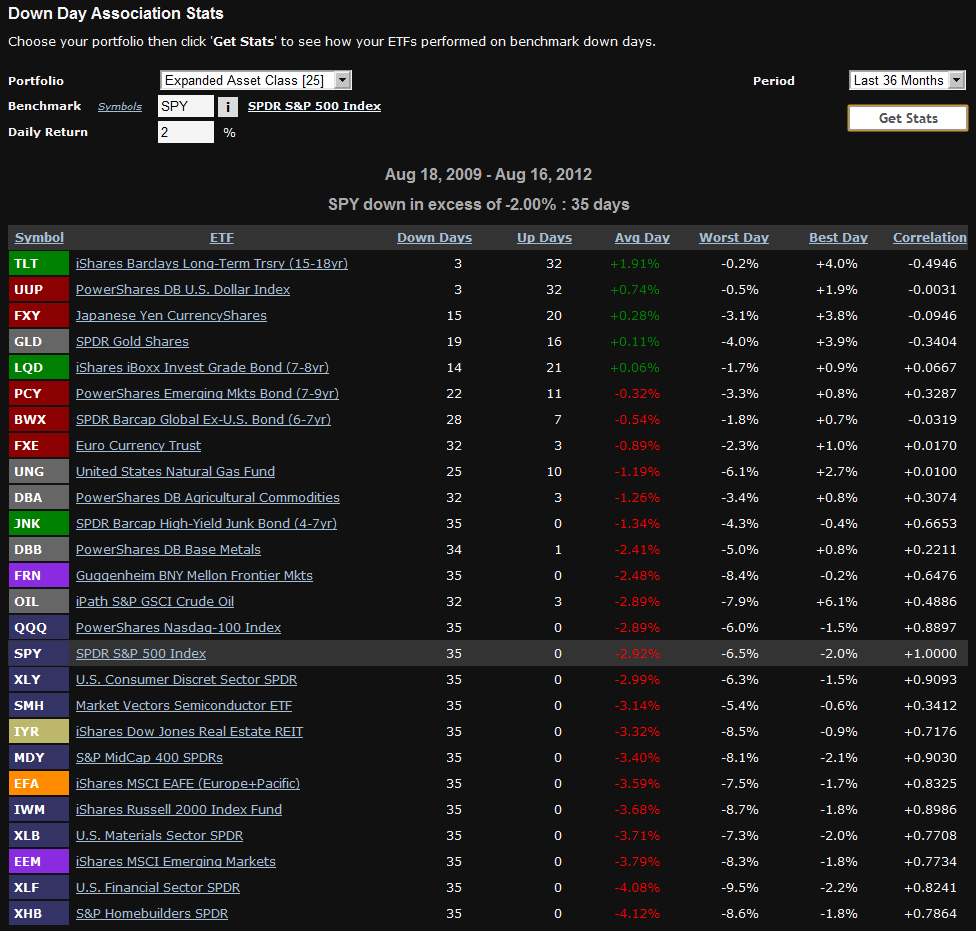
I was thinking about the coming correction in stocks and how to position my portfolio for that moment when equities once again feel the effects of gravity when I stumbled upon an interesting tool at ETFreplay.com that they call their Down Day Association Stats. In a nutshell, it looks at the performance of a group of user-specified exchange-traded products on those days in which a benchmark falls X%.

In the example below, I have chosen SPY as my benchmark, 2% (per day) as my threshold decline and 36 months as my lookback period. I looked at 25 ETPs that cover a wide range of asset classes and investment approaches.

Some of the results from the Down Day Association Stats are not particularly surprising. For instance, the long bond (TLT) and the dollar (UUP) have a strong negative correlation to stocks and generally perform well when SPY declines sharply. Some of the other bond choices (LQD, PCY, BWX) have been better at treading water than countertrending, but also show the benefits of diversification. The commodity choices were somewhat disappointing, generally managing to lose at best half as much as SPY, with crude oil almost matching the declines in the SPY to the penny.

Among the data points that surprised me were that the frontier ETF (FRN) fared better than the SPY in big down days, while real estate (IYR) fared worse.

Of course every decline in stocks has a different set of catalysts and puts different stresses on different asset classes, sectors and geographies, but as stocks continue to grind higher, be sure to make preparations for that eventual pullback, because when it finally does arrive, it will likely do so at an inconvenient time and with surprising swiftness.

Related posts:

[source(s): ETFreplay.com]

Disclosure(s): long LQD at time of writing

Wednesday, April 20, 2011

The VIX, VIX Products and Replication

Jared Woodard of Condor Options is out with a post today, Why I’m Not Worried About VIX Derivatives, in which he reviews some recent FT Alphaville commentary about the difficulty in valuing VIX futures, the idiosyncrasies of various VIX-based products, the shortcomings associated with a synthetic VIX, and the implications for volatility as an asset class.

Over the years (I still can’t believe I am in my fifth year of blogging) I have addressed all of these issues to one degree or another, but seeing some of the points being raised by Jared and the FT Alphaville staff, it looks like time to take a deeper dive into these issues, some related sidebar issues, and make an effort to come up with some sort of unified theory of volatility products. Of course I can’t possibly cover all of the space today, but I can at least dive in.

For starters, here are the four FT Alphaville articles referenced by Jared, which are authored by Izabella Kaminska, Tracy Alloway, as well as Theo Casey of Futures & Options World:

The question that seems to be on everyone’s mind right now is why the VIX is “so low.” Better yet, investors would like to know how low the VIX will go and what some reasonable expectations are for the VIX for the balance of 2011.

First, let me dispense with the idea that the VIX is low. With 10-day and 20-day SPX historical volatility just over 8 and 100-day SPX HV below 12, the VIX is actually a little inflated relative to current measures of realized volatility, even factoring in the standard risk premium.

Second, the VIX is currently in the 32nd percentile of VIX readings going back to 1990. This means that in the 21 years of VIX historical data, the index has been below its current level about one out of every three days.

Third, I think most investors are struggling most with the idea that even with low realized volatility, we have huge issues facing the global economy, including the European sovereign debt crisis, a Japanese nuclear disaster and ripple effect that is far from contained, rising oil prices, strong inflationary pressures across the globe, a huge Fed balance sheet and a host of other formidable threats to economic and political stability.

Fourth, investors are still reeling from the financial crisis of 2008 and the many ways in which that crisis shaped not just a new economic landscape, but a new way in which investors look at the investment world (i.e. "disaster imprinting") and the risks associated with it.

The knee-jerk reaction for many investors is that the VIX is naïve, misguided or perhaps not as relevant as many think it is.

In the links below I address a number of the issues raised by the FT Alphaville staff and Jared. I hope readers will find some insight in these archived posts below, but I promise that in the weeks to come, each of the issues noted above will receive a much more thorough treatment.

In the meantime, do not be surprised if the VIX stays “too low” for an extended period…

Related posts:
Disclosure(s): neutral position in VIX via options

Sunday, March 27, 2011

Webinar: Using Volatility as an Asset Class

I recently participated in a webinar sponsored by AdvisorOne which tackled the subject of volatility as an asset class. Cliff Stanton of Prima Capital was the featured presenter and he presented the highlights from a white paper he authored, Volatility as an Asset Class. For those who are interested, I recommend clicking through the link above (free registration required) to review the white paper, which takes an in-depth look at the VIX over the course of 17 pages, from the index and its idiosyncrasies to the VIX futures and the first generation of VIX ETNs, VXX and VXZ.

As far as the VIX white paper is concerned, it would be a stretch for me to take issue with any of the analytical work or conclusions derived from the data. Instead, I chose to define the problem of volatility as an asset class more broadly and look at short volatility strategies, long-short strategies and VIX strategies that focus on the VIX futures term structure. In doing so, my comments build on my January 12th Barron’s article, Ways to Turn Volatility into an Asset Class and make what I believe is a strong case for volatility products as an asset class.

AdvisorOne has archived the full Using Volatility as an Asset Class webinar here (free registration required)

Finally, since I have already gone out of my way to proclaim 2011 as the year volatility becomes a mainstream asset class, I will have a lot more to say about this subject in the weeks and months ahead.

Related posts:

Disclosure(s): none

Wednesday, January 12, 2011

Guest Columnist at The Striking Price for Barron’s

The last few times I have been asked to be a guest columnist for The Striking Price on behalf of Steven Sears at Barron’s, there has been a spike in volatility just about the time I go to commit my thoughts to paper keyboard + monitor. I had begun to think that the folks at Barron’s were somehow omniscient and knew when to put in a call to the bullpen for “that volatility guy.”

So when the call came again, I immediately had a Pavlovian urge to buy up some VIX calls, but alas the markets have been calm. Everyone seems to be wondering where the pullback is. If today’s column is not the catalyst, I’m not sure what it will take.

Speaking of which, I have elected to focus on volatility as an asset class for today’s guest column, which bears the title, Ways to Turn Volatility into an Asset Class. Part of my thesis is that 2011 is the year that volatility goes mainstream, largely due to the rise of volatility-based exchange-traded products, which are in the process of bringing volatility trading to the masses. I also repeat an earlier assertion that before the year is over, XVIX and XIV will gain significant traction as buy and hold volatility vehicles. For all the details, click through to read the original.

…and if we do see a major pullback soon, I expect the timetable to accelerate for investors to begin to embrace the stable of 15 volatility-based ETPs.

Related posts:

A full list of my Barron’s contributions:
Disclosure(s): long XIV and XVIX at time of writing

Tuesday, January 4, 2011

The Year in VIX and Volatility (2010)

One of everybody’s favorite charts from a year ago was the basis for Chart of the Week: The VIX and Volatility in 2009, in which I created a fairly concise annotated summary of the year in VIX and volatility.

For some reason, the same chart seemed harder to create for 2010, partly because the volatility triggers were less discrete and seemed to arrive in recurring waves, each time apparently posing a different size threat. The European sovereign debt crisis is a prime example of the waves of threats, as are the concerns about China’s ability to navigate the dual hazards of slowing growth and rising inflation. In the U.S., concerns about a double-dip recession waxed and waned, while investors scratched their heads wondering just how much to worry about the foreclosure crisis or events on the Korean peninsula.

On the volatility side, the highlights of 2010 included the ‘flash crash’ in May and an even bigger VIX spike (to 48.20) toward the end of the month as the European sovereign debt crisis threatened to snowball out of control, pushing the VIX to a higher close than at any point prior to the 2008 financial crisis.

Investors also struggled under the psychological weight of the Deepwater Horizon oil spill in the Gulf of Mexico, which imparted a sense of helplessness across the U.S. and helped to dampen any sort of optimism about the economy and perhaps even technological progress in general.

In spite of all this, stocks rallied impressively for the last four months of the year, due in part to a second round of quantitative easing on the part of the Fed.

The year saw record volumes in a number of VIX-related products and included new daily record volumes in VIX options (June 11), VIX futures (November 16) and the increasingly popular iPath S&P 500 VIX Short-Term Futures ETN, which most investors know by its ticker symbol, VXX (November 23).

Volatility made its mark as a peripheral asset class in 2010, with VIX-based ETNs, making it much easier for retail investors to make direct investments in volatility. My guess is that this development is just a beginning and 2011 could mark a watershed year in terms of recognizing of volatility as a mainstream asset class.

Related posts:


[source: StockCharts.com]

Disclosure(s): short VXX at time of writing

Friday, December 17, 2010

VIX and More and the 2011 Bespoke Roundtable

For the second year in a row, I have elected to stick my neck out and make my best guess at what the investment world will look like in the coming year in conjunction with the Bespoke Investment Group’s second annual roundtable.

As someone who has a tendency to focus almost all of my predictive powers on the next two options expiration cycles, I find that forcing myself to think in terms of a one year time horizon is a daunting task. Still, just going through the process and committing some ideas to paper makes this exercise worthwhile and fun.

Frankly, I was surprised by how accurate many of my predictions from last year turned out to be and for better or (more likely) for worse, this has emboldened me to be even more provocative and more specific this year, including some outrageous comments about AAPL.

More to the main theme of this blog, I think readers may find the following predictions for 2011 to be of interest:

2011 will mark the rise of volatility as an asset class.  Part of the reason for this rise will be the runaway success of VIX-based ETNs and ETFs, notably the recently launched XIV, which will prove that volatility vehicles can be good buy-and-hold investments.  XVIX will also prove to be a popular and successful buy-and-hold ETN and once liquidity improves, TVIX will hit a tipping point and become the darling of day traders.”
All in all, a dozen top bloggers offered up their predictions for 2011. Bespoke has assembled some of the highlights from the responses here.

Additionally, there is a to the the full text of my replies to all 34 questions about 2011 here.

For those financial anthropologists in the crowd, the highlights for the 2010 roundtable are here and my archived predictions for 2010 are here.

[12/19/10 Update:  note that there were several incorrect links to Bespoke that have since been corrected ]

Related posts:

Disclosure(s): long XIV and XVIX at time of writing

Friday, September 24, 2010

More on the Multi-Asset Class ETF Portfolio

Yesterday’s post, Diversification, Momentum and Sidestepping the 2008 Panic, brought such a positive response that I thought a brief follow-up is in order.

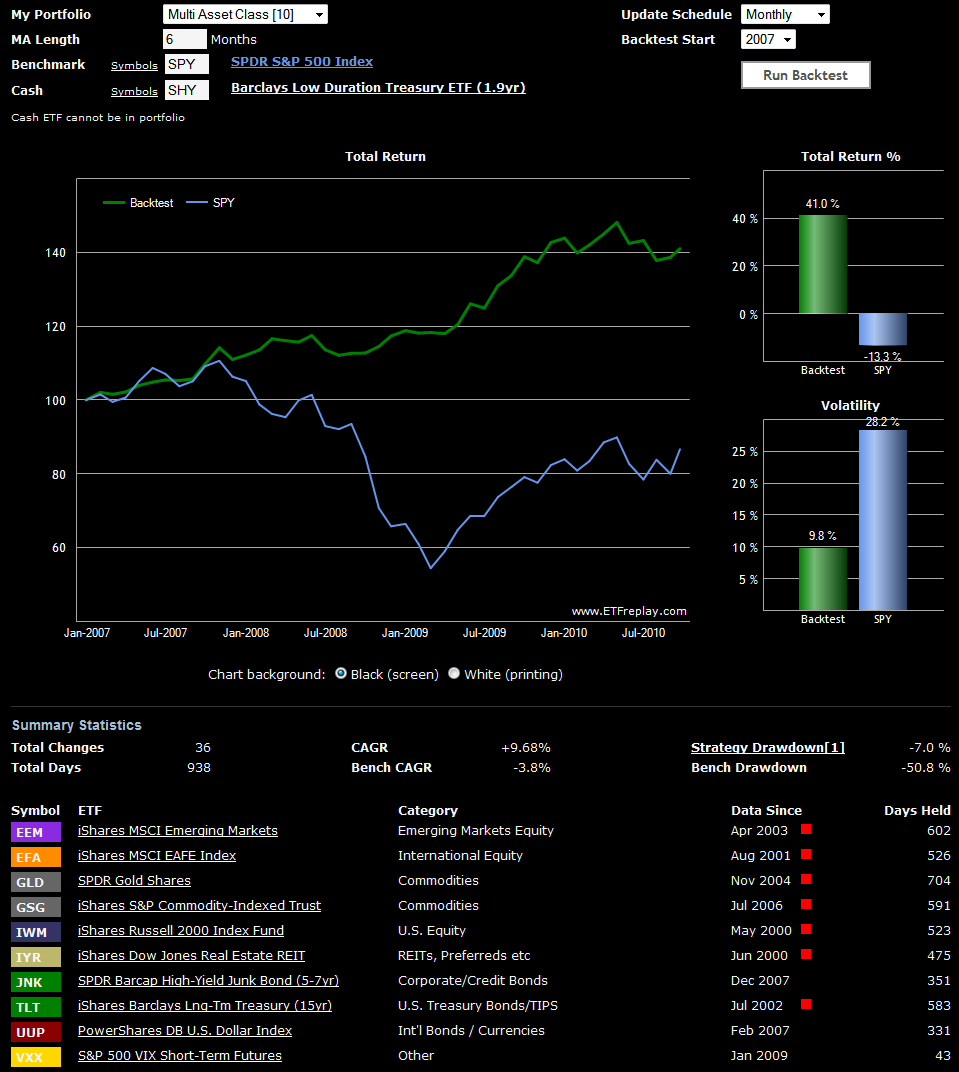
In the chart below, courtesy of ETFreplay.com, I show how the Multi-Asset Class ETF Portfolio I referred to yesterday performed on a month to month basis, this time using the ETFreplay’s Portfolio Moving Average timeline tool. The chart is really a table which shows all of the ETFs and the results of the moving average rule which determined whether to be long or in cash for each month of the period covered. The far right portion of that graphic also shows where the each of the individual ETFs currently stands relative to their selected (in this case it was six months) moving average.  Finally, the column graph toward the bottom also shows what percentage of the total ETF portfolio was long in each month.

As an aside, someone asked for a recommendation on a site for backtesting stocks based on fundamental data. My suggestion was to check out Portfolio123.com, which is the site discussed in the bottom of the links below.

Related posts:


[source: ETFreplay.com]

Disclosure(s): none

Thursday, September 23, 2010

Diversification, Momentum and Sidestepping the 2008 Panic

While most trading systems I know – including my own – struggled to eke out a profit during the 2008 financial crisis, it is certainly worth investigating which sort of strategies and approaches might have allowed investors not just to sidestep the 2008 panic, but to profit from it.

Using some functionality recently released by ETFreplay.com, I assembled a portfolio of ten ETFs from multiple asset classes and tested that portfolio in ETFreplay’s Portfolio Moving Average backtesting tool, which evaluates each ETFs relative to a moving average and goes long if the ETF is above the specified moving average (MA) and is in cash when the ETF is below the MA. I experimented with a variety of moving averages up to 12 months and from time periods going back to 2003 (recall that most ETFs do not have an extensive history) and came up with some interesting results.

The chart below shows the Multi Asset Class ETF portfolio since the beginning of 2007, using a 6 month MA (results were better using a 7-10 month moving average) as the evaluation period. Note that even during these tumultuous times, the long/cash strategy over the ten ETFs suffered a maximum drawdown of only 7%, had volatility that was only about 1/3 as much as the S&P 500 index (SPY) and managed a cumulative return of over 42% while stocks in general were putting up double-digit losses.

Of course my point is not that the strategy described below is the holy grail when it comes to risk-adjusted returns, but that investors should take advantage of tools like the one mentioned above to tinker with ideas and tactics in order to refine existing strategies or perhaps devise new ones.

ETFs offer incredible diversification across all asset classes and in today’s markets, every little extra edge helps.

Related posts:


[source: ETFreplay.com]

Disclosure(s): none

Wednesday, December 26, 2007

Portfolio Rebalancing, Diversification, and ETFs

In addition to dreaming about the great investment opportunities of 2008, the end of the year is a time when many investors think about rebalancing their portfolios, enhancing diversification, and lowering risk. It is also a good time to cut loose bad ideas and bad investments, while at the same time opening one’s mind to the possibility of new types of investments.

I can’t say where the best opportunities for 2008 lie, but I can tell you where to find them. Without a doubt, many the best investments for 2008 will found among the ETF universe. This should not come as a surprise, as the ETF universe has, by far, the broadest array of investment vehicles. So while some individual stocks may top next year’s list in terms of total return, the careful selection of a few ETFs in new asset classes will provide a better opportunity to enhance returns and lower overall portfolio risk at the same time.

While there are a number of places to research and screen ETFs, I am also a fan of those handy one page ETF ‘cheat sheets’ put out by Bespoke Investment Group: the US ETF Family Tree; and the Global ETF Family Tree, each of which are superbly organized. For my purposes, however, I can do one better with a four page PDF from ETF Guide: ETF Reference Guide 2007 Q4. Updated quarterly, this document gives me four important pieces of information that are not available from the Bespoke cheat sheets:

  1. Indication of which ETFs are optionable
  2. Average daily volume
  3. Expense ratio
  4. Expense ratio median for each category

Armed with this information, now is as good a time as any to start thinking about how to take advantage of the changing mix of investment opportunities – and the ETFs that can expand the scope of your investment reach.

Tuesday, December 18, 2007

Volatility as an Asset Class I

I am beginning to believe that to some extent, this blog may be carrying the seeds of its own destruction. Specifically, the worst thing about trading and blogging about volatility is that when stuff hits the fan, the best trading and blogging setups both spike at the same time. So…if sometimes it seems to take longer for me to comment on various market action and volatility-related topics just when these topics seem juiciest of all, well it is probably a case of my trading taking precedence over my blogging.
On that note, let me open a new can of worms that I will come back to regularly and in more detail: volatility as an asset class.

There has been considerable discussion in the past few days about whether or not volatility should be considered an asset class, much of it spurred by a Barron’s article over the weekend authored by Steven Sears and bearing the title Volatility: Finally Getting Respect.

The subject of volatility as an asset class is a fairly complex one and for now I have just enough time and space here to introduce it, provide some links, and promise to be back with some analysis and opinions soon.

Before getting in to volatility, there is another perhaps larger can of worms regarding what exactly an asset class is. I am going to pass on this issue for now, other than to say that I think the Wikipedia asset class examples are an excellent way to think about the subject.

Getting back to volatility as an asset class, this subject has been discussed in some circles for at least the past five years, but the idea has received increasing media attention in the last year or two. The Financial Times was talking about Why Volatility Becomes an Asset Class in May 2006, while Hafner and Wallmeyer published an academic paper Volatility as an Asset Class: European Evidence last year that had been widely distributed in previous incarnations in 2005. Three months ago, a book edited by Izzy Nelken of Super Computer Consulting was published with the title Volatility as an Asset Class. For those who are interested, the book is available through Amazon. To get a sense of how far along this idea has progressed, Euromoney Training was recently offering a training program on the subject of volatility as an asset class.

To complete the laundry list of links, here are four excellent posts triggered by the Steven Sears article from some of my favorite bloggers on the subject of volatility as an asset class:

More to follow on this subject, as soon as that pesky market volatility takes a bit of a breather…

DISCLAIMER: "VIX®" is a trademark of Chicago Board Options Exchange, Incorporated. Chicago Board Options Exchange, Incorporated is not affiliated with this website or this website's owner's or operators. CBOE assumes no responsibility for the accuracy or completeness or any other aspect of any content posted on this website by its operator or any third party. All content on this site is provided for informational and entertainment purposes only and is not intended as advice to buy or sell any securities. Stocks are difficult to trade; options are even harder. When it comes to VIX derivatives, don't fall into the trap of thinking that just because you can ride a horse, you can ride an alligator. Please do your own homework and accept full responsibility for any investment decisions you make. No content on this site can be used for commercial purposes without the prior written permission of the author. Copyright © 2007-2023 Bill Luby. All rights reserved.
 
Web Analytics