Showing posts with label FRN. Show all posts

Friday, August 17, 2012

What If Stocks Decline?

Successful investors are the ones that are always making plans for all sorts of contingencies, so it stands to reason that they should even prepare themselves for the possibility of stocks actually declining one of these days...

I was thinking about the coming correction in stocks and how to position my portfolio for that moment when equities once again feel the effects of gravity when I stumbled upon an interesting tool at ETFreplay.com that they call their Down Day Association Stats. In a nutshell, it looks at the performance of a group of user-specified exchange-traded products on those days in which a benchmark falls X%.

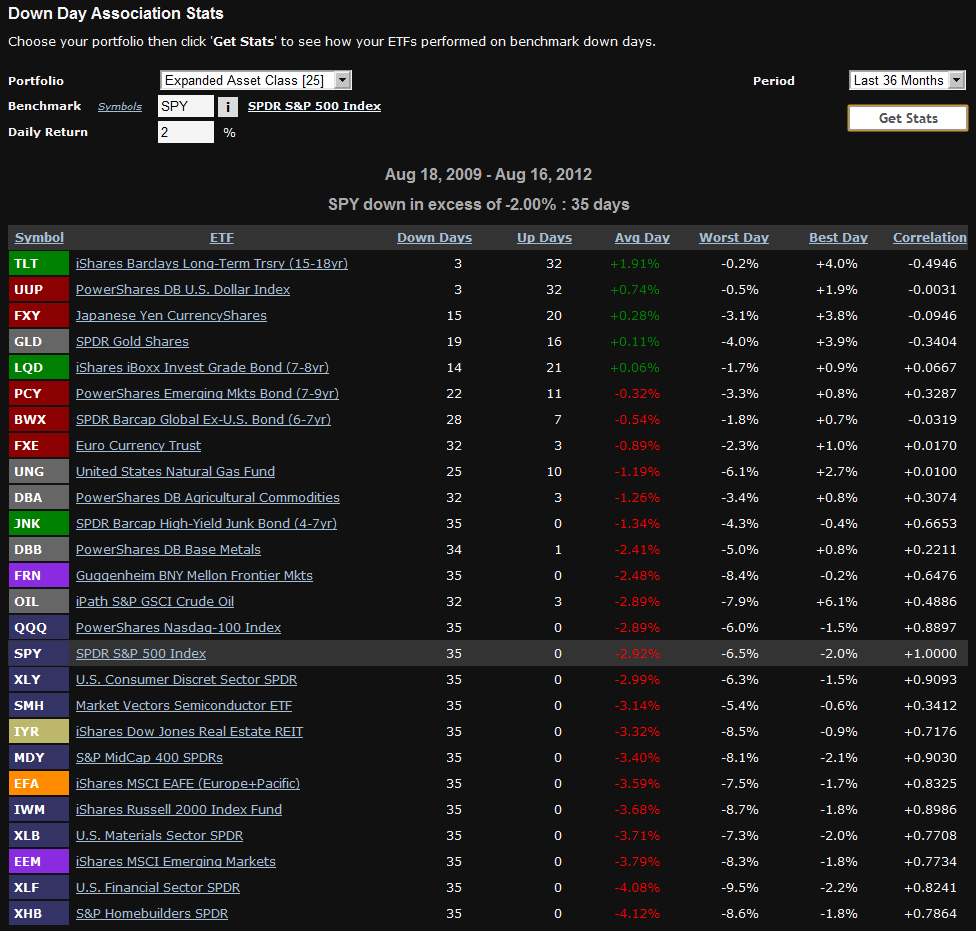
In the example below, I have chosen SPY as my benchmark, 2% (per day) as my threshold decline and 36 months as my lookback period. I looked at 25 ETPs that cover a wide range of asset classes and investment approaches.

Some of the results from the Down Day Association Stats are not particularly surprising. For instance, the long bond (TLT) and the dollar (UUP) have a strong negative correlation to stocks and generally perform well when SPY declines sharply. Some of the other bond choices (LQD, PCY, BWX) have been better at treading water than countertrending, but also show the benefits of diversification. The commodity choices were somewhat disappointing, generally managing to lose at best half as much as SPY, with crude oil almost matching the declines in the SPY to the penny.

Among the data points that surprised me were that the frontier ETF (FRN) fared better than the SPY in big down days, while real estate (IYR) fared worse.

Of course every decline in stocks has a different set of catalysts and puts different stresses on different asset classes, sectors and geographies, but as stocks continue to grind higher, be sure to make preparations for that eventual pullback, because when it finally does arrive, it will likely do so at an inconvenient time and with surprising swiftness.

Related posts:

[source(s): ETFreplay.com]

Disclosure(s): long LQD at time of writing

Monday, February 7, 2011

Chart of the Week: EGPT and Collateral Damage

Unrest in Egypt is barely three weeks old and already the ripple effect has crossed the globe in several waves.
I find it interesting how regional and country ETFs can be of some assistance in evaluating how investors are thinking in terms of contagion risk, be it political or economic – or at the very least in terms of the breadth and depth of the economic impact of specific events.

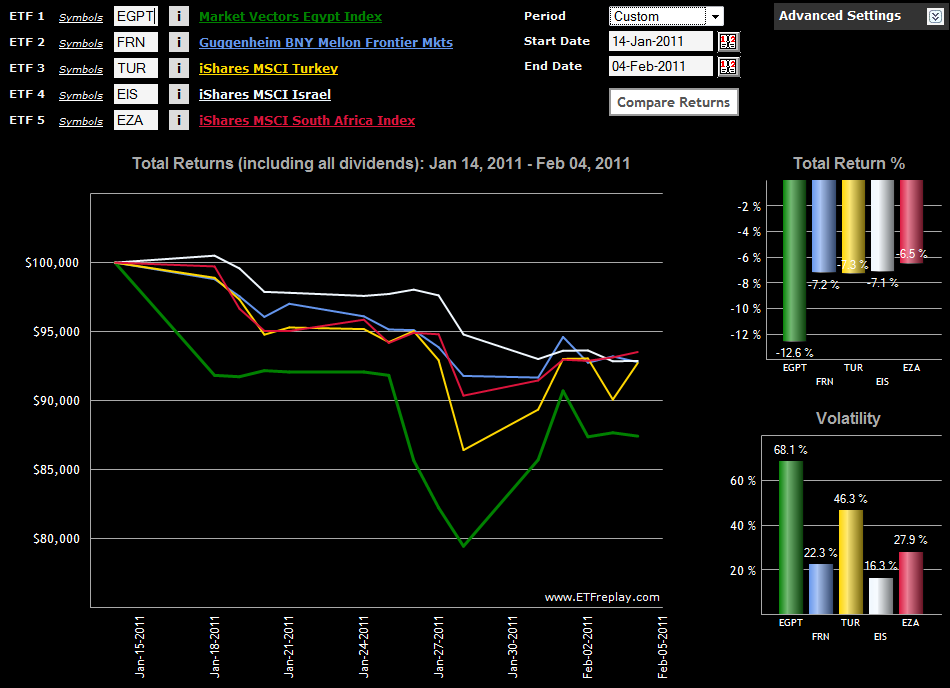
In this week’s chart of the week, I endeavor to track some elements of the relative geographical spread of concern with a handful of ETFs. The baseline ETF, EGPT, shows how the situation deteriorated over the long weekend in the U.S. from January 14th to January 18th, then began to accelerate downward during the January 26th trading session.

In terms of impact, the additional four ETFs include one broad-based frontier ETF, FRN, and three single-country ETFs: Turkey (TUR); Israel (EIS); and South Africa (EZA). Of this group, the Turkey ETF has proven to be the most volatile during the crisis and also suffered the largest drawdown. Interestingly, the Israel ETF has been the least volatile of the group, but the only one which appeared not to find a bottom on January 28th and continued to trend lower. The top performer of the group is EZA, the South African ETF. EZA has fallen slightly more than half as far as EGPT since the beginning of the crisis and has steadily gained strength during the past week. Among country ETFs, EGPT and TUR were the top two performers during the past week.

Note that there are several regional ETFs which cover northern Africa and the Middle East. I discussed these during the Dubai crisis at some length in Frontier ETFs and Chart of the Week: Market Vectors Gulf States ETF (MES).

Related posts:


[source: ETFreplay.com]

Disclosure(s): long TUR at time of writing

Monday, November 30, 2009

Frontier ETFs

In yesterday’s chart of the week, I looked at three ETFs with exposure to the Middle East:

  • Market Vectors Gulf States ETF (MES)
  • Wisdom Tree Middle East Dividend ETF (GULF)
  • SPDR S&P Emerging Middle East and Africa ETF (GAF)

It is a little known fact that Middle Eastern ETFs are actually subset of a relatively new class of ETFs called frontier ETFs. Many of these frontier ETFs are single country ETFs, but two in particular stand out as diversified frontier plays:

  • PowerShares MENA Frontier Countries Portfolio ETF (PMNA)
  • Claymore/BNY Mellon Frontier Markets ETF (FRN)

I list PMNA (holdings) first because it is not a global, but a regional ETF, based on the NASDAQ OMX Middle East North Africa Index. At present the fund has a strong emphasis on the Persian Gulf and should be considered as a slightly more liquid (but still relatively illiquid) alternative to MES and GAF, trading approximately 10,000 shares per day. As of last week, the top country allocations were in the United Arab Emirates (22.6%), Egypt (20.2%) and Kuwait (16.9%).

In contrast to PMNA, FRN (holdings) has taken a much broader and more geographically diversified global approach, without a particular regional emphasis. Specifically, the ETF is designed to track the Bank of New York Mellon New Frontier DR Index. As of September 30, the top country allocations were Chile (28.6%), Poland (15.9%) and Egypt (15.4%).

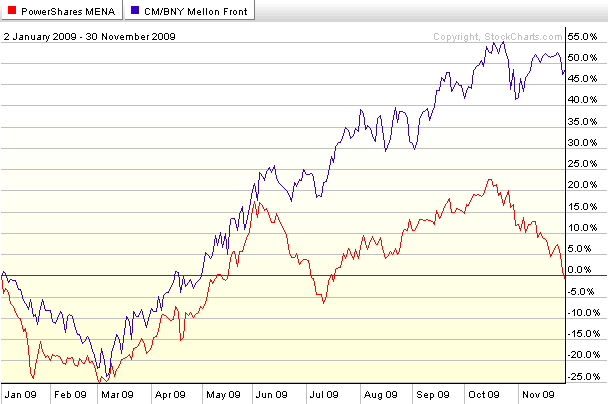
The chart below shows that the while PMNA and FRN were very similar in terms of performance for the first five months of 2009, the more diversified FRN had been a much stronger performer during the latter half of the year. Not surprisingly, given PMNA's exposure to the Persian Gulf, the gap has widened significantly during the last few days.

In addition to these multi-country frontier ETFs and regional frontier ETFs such as Market Vectors Africa (AFK), it is important to keep in mind that there are many single country ETFs available, with an increasing amount of geographical diversity. Just last week, the first Poland ETF (PLND) was launched. For investors who are interested in single country Middle Eastern ETFs, Van Eck is planning to launch new ETFs for Egypt and Kuwait.

Finally, consider that frontier ETFs are likely to appeal only to investors who can tolerate high levels of risk. The multi-country and single country variants suffer from low liquidity and high volatility, making it unwise to build up large positions until trading volumes increase dramatically from current levels.

[source: StockCharts.com]

Disclosure: none

DISCLAIMER: "VIX®" is a trademark of Chicago Board Options Exchange, Incorporated. Chicago Board Options Exchange, Incorporated is not affiliated with this website or this website's owner's or operators. CBOE assumes no responsibility for the accuracy or completeness or any other aspect of any content posted on this website by its operator or any third party. All content on this site is provided for informational and entertainment purposes only and is not intended as advice to buy or sell any securities. Stocks are difficult to trade; options are even harder. When it comes to VIX derivatives, don't fall into the trap of thinking that just because you can ride a horse, you can ride an alligator. Please do your own homework and accept full responsibility for any investment decisions you make. No content on this site can be used for commercial purposes without the prior written permission of the author. Copyright © 2007-2023 Bill Luby. All rights reserved.
 
Web Analytics