Showing posts with label MSFT. Show all posts

Wednesday, June 8, 2011

Apple Products vs. Platform

Apple (AAPL) is an unusual stock for several reasons, not the least of which is the strong retail demand for the stock and a large contingent of customer-zealots who regularly worship at the altar of Steve Jobs.

Throw together the factors mentioned above, Apple’s history of important product announcements at major events and the return of Jobs and his unique talent for unveiling new cutting edge products and you get an interesting confluence of events – and expectations – at Monday’s Apple Worldwide Developers Conference.

These conferences are always abuzz with rumors and speculation about the next big thing that Apple is going to announce which will once again change the technology landscape. When is the next iPad coming? What new features will it include? When will the iPhone 5 be out? What will the next iOS and Mac OS operating systems do? What will be the implications for the devices they run? What is the iCloud and what does it mean?

In the end, those hoping for groundbreaking new products were disappointed. The iPad, iPhone, iPod, MacBook, iMac, Mac Pro, AppleTV, etc. were not on stage. Instead, the hardware devotees had to settle for innovations which were confined to operating systems enhancements and the iCloud – stuff you can’t wait in line for at an Apple store, take home and dazzle your friends and family with.

The irony is that the obsession with hardware misses the big point. New products are critical to Apple’s business, but at best it gets them a first mover advantage that is not guaranteed to endure. The truth is that from a strategic perspective the iCloud is much more important to Apple’s future than any new product, because the iCloud is a platform play that enhances the value of the full range of Apple products and services, including future products and services.

Let me illustrate this with a personal example. I have about a quarter of a century of PC-based computer experience. I probably owned two dozen laptops before I bought my first Apple product, an iPhone. When the iPad 2 came out, however, it was easy for me to expand my stable of Apple products. Now that I am habituated to iTunes and the App Store, it is easier for me to contemplate something like the MacBook. With all of these devices seamlessly sharing data in the background on the iCloud, the data argument for expanding my suite of Apple products becomes that much more compelling. It is a similar story for my wife, who only recently began playing with her first Apple product, the iPad. She has been so completely won over that an iPod will soon follow and then I’m betting an iPhone will be too difficult to ignore. By the time she gets around to replacing her laptop, I’m fairly sure the MacBook Air will win her over – even if she doesn’t even know what it is right now.

I suspect that something similar is in the process of happening across the globe. Many of us who have spent the majority of our careers in a PC-centric corporate environment have often found Apple products to be too much of a compatibility issue to be worth the trouble. They have been relegated to toy status rather than serving as our our central computing devices. The iCloud gives Apple a chance to convert those PC cling-ons not only to exciting Apple products and services, but to a iCloud data world that could be a platform revolution. Device-independent data sharing is just around the corner and Microsoft (MSFT), Google (GOOG) and their ilk better have a strong alternative – and soon.

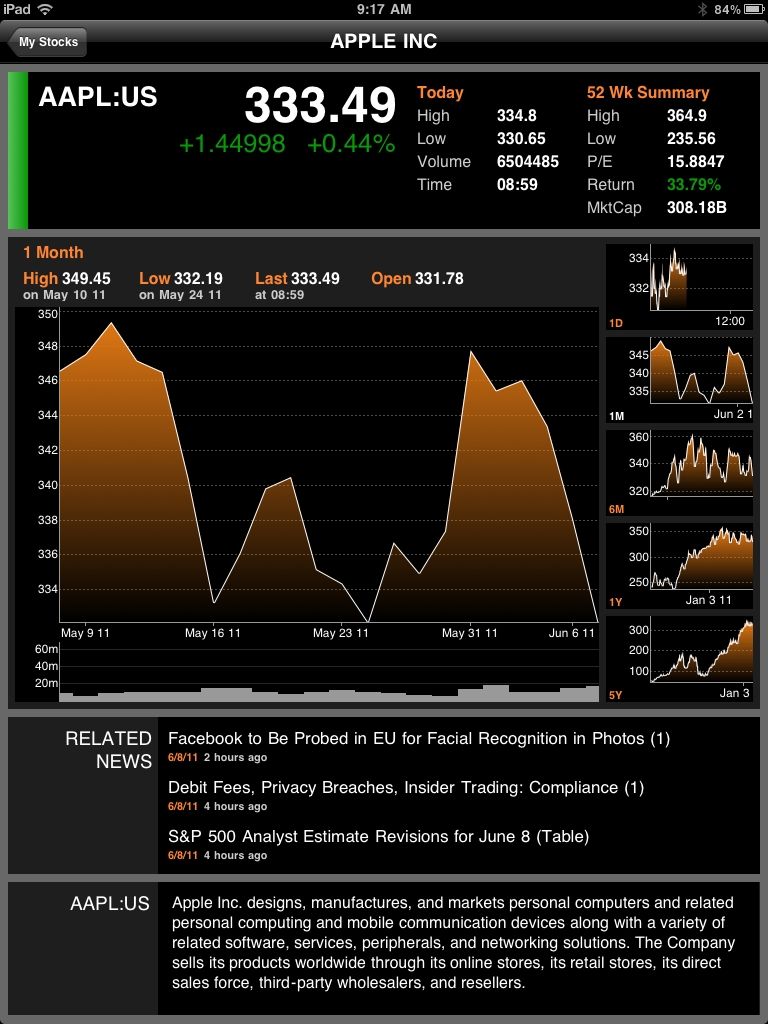
As for AAPL stock, it is down about 3% since Steve Jobs took the stage on Monday. Savvy investors should be thinking more about Brian Arthur’s Increasing Returns and the New World of Business and less about the timing of new product announcements.


[graphic: Bloomberg for iPad]

Disclosure(s):
long AAPL at time of writing

Sunday, April 5, 2009

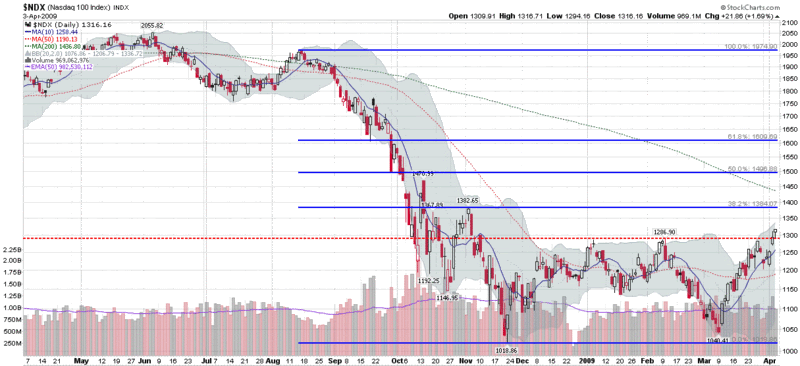
Chart of the Week: The Resurgent NASDAQ-100

Technology is back and large cap technology is helping to lead the recent rebound in equities.

Even after a four week rally, 2009 has been mostly a sea of red. In fact, the two headline indices, the Dow Jones Industrial Average and S&P 500 index, are down 8.65% and 6.73% so far in 2009. Neither large caps nor small caps are performing particularly well, with the large cap S&P 100 (OEX) down 8.27% and the small cap Russell 2000 (RUT) down 8.67% year to date.

The technology-heavy NASDAQ has been a very different story, with both the NASDAQ composite index (+2.84%) and NASDAQ-100 (+8.63%) in the green.

In the chart of the week below, I have highlighted the NASDAQ-100 index (NDX), which closed at its highest level since early November on Friday, following a strong earnings report and increased guidance from Research in Motion (RIMM). The NDX is a weighted index of the largest 100 companies in the NASDAQ, as measured by market capitalization. As such, the largest weightings read like a who’s who list of large technology companies: Microsoft (MSFT); Google (GOOG); Cisco (CSCO); Apple (AAPL); Oracle (ORCL); Intel (INTC); Qualcomm (QCOM); etc.

Whether or not the resurgent NDX can continue to rally and retrace its steep drop from September and October will go a long way toward determining if the broader markets will be able to gain enough momentum to also finish 2009 in the green.


[source: StockCharts]

Monday, January 19, 2009

Options Action Debuts, Looks Like Fast Money With Options Trades

Options Action is a new options-oriented show that made its debut on CNBC on Friday night at 11:30 ET. Hosted by Melissa Lee, the show is clearly an options derivative of Fast Money, from the format to the graphics to the audio.

Given the choice between targeting options-savvy viewers and a broader audience, CNBC has elected to aim for the generalist audience by emphasizing the news and issues, while including some recommended stock trades along with the options trades. If you have a casual interest in options, this show could help grow your knowledge base; if you already consider yourself to be a relatively sophisticated options trader, Options Action is not likely to have a great deal of appeal.

The format relies on current news and investment issues, with Melissa Lee keeping things moving by prompting the guests for some brief analysis and asking for recommended stock and options trades. Financials were the top story on Friday, with some debate about the plight of Wells Fargo (WFC). Steve Jobs and Apple (AAPL); crude oil; and Microsoft (MSFT) vs. Google (GOOG) were the other items on the agenda.

For a debut offering, I thought guests Joe Terranova, Stacey Gilbert, Jim Iurio, Mike Khouw and Brian Stutland did an excellent job of bringing a variety of perspectives to bear on each issue, with reasonably strong interplay among the group. My favorite part of the show centered around the discussion of a naked sale of Google June 300 puts for 43.00, as recommended by Stutland, or selling a put spread instead, as recommended by Gilbert.

In terms of options-specific material that you might not find on Fast Money, in addition to the proposed options trades, there was a quick blurb on unusual options volume at United Technologies (UTX) as well as several charts that showed five day options volume trends in some of the other featured companies. Other than that, the name of this program could easily have been Fast Money: Options Edition.

CNBC has Friday’s show archived in three parts for anyone who wants to see what they missed:

  • Part 1 -- Wells Fargo and the financials; Apple; crude oil
  • Part 2 -- Microsoft vs. Google
  • Part 3 -- Final trades: Apple, ConocoPhillips (COP), Microsoft, infrastructure plays

Monday, October 13, 2008

Institutional Interest High in These Nine Large Caps

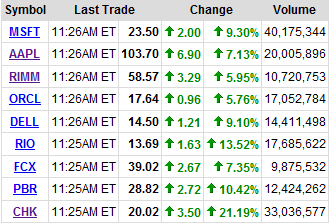
Stocks of all sizes and shapes are trading up today, but which ones will continue to do well if the market holds up?

In the graphic to the right (courtesy of Yahoo) I highlight nine large cap stocks that appear to be the biggest targets of institutional interest not just today, but when the markets moved up in spurts last week too. Those that made the cut did so on the basis of several price factors and several volume factors. The list consists of five technology names (MSFT, AAPL, RIMM, ORCL, and DELL), two mining/metals stocks (RIO, FCX), and two energy stocks (PBR and CHK). Interestingly, two of the nine companies are based in Brazil.

At the very moment at least, these nine companies look to be at the top of the heap: quality stocks at attractive valuations, with considerable institutional interest. I would expect these names to continue to lead the way in subsequent bull moves.

Note that one company on this list may be somewhat of a special case. Chesapeake Energy (CHK) CEO Aubrey McClendon was forced to sell “substantially all” of his 33 million shares last week to meet a margin call. With that forced selling completed, the stock is bouncing back today.

DISCLAIMER: "VIX®" is a trademark of Chicago Board Options Exchange, Incorporated. Chicago Board Options Exchange, Incorporated is not affiliated with this website or this website's owner's or operators. CBOE assumes no responsibility for the accuracy or completeness or any other aspect of any content posted on this website by its operator or any third party. All content on this site is provided for informational and entertainment purposes only and is not intended as advice to buy or sell any securities. Stocks are difficult to trade; options are even harder. When it comes to VIX derivatives, don't fall into the trap of thinking that just because you can ride a horse, you can ride an alligator. Please do your own homework and accept full responsibility for any investment decisions you make. No content on this site can be used for commercial purposes without the prior written permission of the author. Copyright © 2007-2023 Bill Luby. All rights reserved.
 
Web Analytics