Showing posts with label WFC. Show all posts

Saturday, March 7, 2009

Chart of the Week: Four Good (?) Banks

I wish there were something other than the banks to talk about for this week’s chart of the week, but until further notice, the banks are the story and it is inviting trouble to look past this fact for any period of time.

It was not too long ago that JPMorgan Chase (JPM), Bank of America (BAC), Wells Fargo (WFC) and US Bancorp (USB) were being held up as examples of four large relatively strong banks that were likely to emerge from the current financial crisis as the dominant large American banks.

At this stage of the game, it appears as if Bank of America is clearly in trouble, Wells Fargo is coming under increased scrutiny, and even stalwarts JPMorgan Chase and US Bancorp are seeing confidence and share prices eroding rapidly. Dividend cuts and insider purchases have done little to stem the tide of value destruction and comments by the Obama administration to the effect that they are strongly in favor of private ownership of the banks have provided no more than a temporary reprieve.

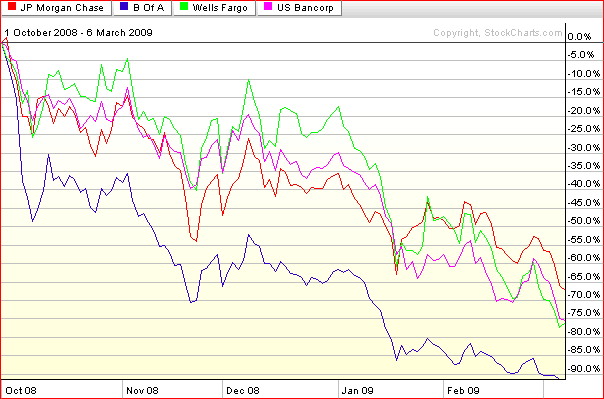
The chart below shows the performance of these ‘good’ banks in the post-Lehman period. During that period, JPMorgan Chase has been the top performer in the group, losing 2/3 of its value, while losses at Wells Fargo and US Bancorp are now over 75%. Bank of America is down over 90% during the same period.

Since I am on the subject, I thought I might point out that Global Finance has just compiled a list of the World’s 50 Safest Banks. The top U.S. bank on the list is Wells Fargo at #21. US Bancorp is #26, JPMorgan Chase is #47 and the only other U.S. bank on the list is The Bank of New York Mellon (BK), which comes in at #35.
[source: StockCharts]

Friday, February 20, 2009

Global Bank Stocks in a Post-Lehman World

I get tired of talking about the banks, but it is the story for the foreseeable future. While Citigroup’s (C) common stock flirts with the 2.00 line (can we call it Bank of Mendoza?) and insists it has not had conversations with the government about nationalization, Bank of America (BAC), whose stock is barely above the 3.00 level, is also out saying, “We see no reason to nationalize a bank that is profitable, well capitalized and actively lending.” Add to the financial stew a Wells Fargo (WFC) stock under 10.00 for the first time since 1996 and it is hard not to be obsessed by the banking sector.

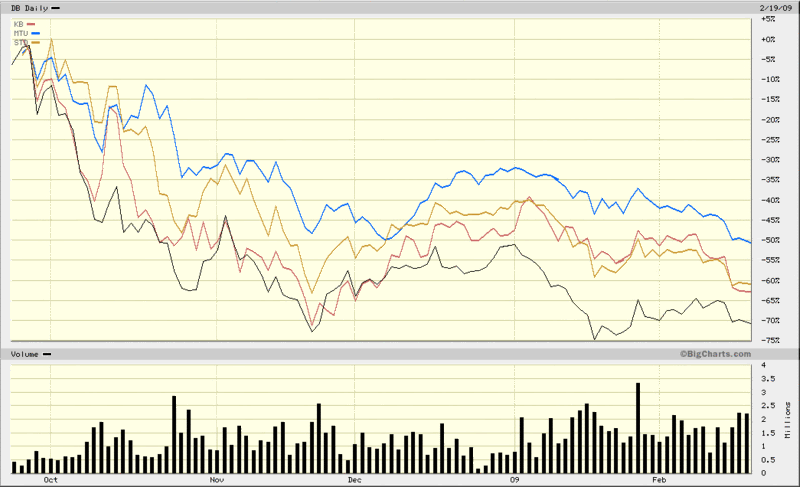
For all the discussion of U.S. banks, I wish to turn to the global scene. Lately U.K. banks and Irish banks have been the target of rumblings about possible nationalization, so I am going to skip over banks from these countries and instead focus on the largest banks in two critical European countries (Germany and Spain) and two critical Asian countries (Japan and South Korea). These four banks are Deutsche Bank (DB), Banco Santander (STD), Mitsibushi UFJ Financial (MTU) and Kookmin Bank (KB). All four banks happen to trade in the U.S. via American Depository Receipts (ADRs).

In the chart below, I have graphed the performance of all four giant banks since the last week in September, when the ripple effects of the Lehman bankruptcy and nationalization of AIG began to be felt across the globe. Not surprisingly, all four banks have seen their stock prices fall by more than 50%, with Deutsche Bank the worst performer among the group and Mitsibushi UFJ Financial feeling the least amount of pain. For comparison purposes, most of the Irish and British banks are down more than 90% during the same period.

The global banking crisis obviously has a long way to go before anyone can say with confidence that it is behind us. In the interim, even a medium-sized bank from a country most U.S. investors are not watching closely can lead to another tipping point that puts the global financial system closer to the brink. Investors seeking to keep a weather eye on global financial firms may also wish to monitor closely the iShares Global Financials ETF (IXG).

[source: BigCharts]

Monday, January 19, 2009

Options Action Debuts, Looks Like Fast Money With Options Trades

Options Action is a new options-oriented show that made its debut on CNBC on Friday night at 11:30 ET. Hosted by Melissa Lee, the show is clearly an options derivative of Fast Money, from the format to the graphics to the audio.

Given the choice between targeting options-savvy viewers and a broader audience, CNBC has elected to aim for the generalist audience by emphasizing the news and issues, while including some recommended stock trades along with the options trades. If you have a casual interest in options, this show could help grow your knowledge base; if you already consider yourself to be a relatively sophisticated options trader, Options Action is not likely to have a great deal of appeal.

The format relies on current news and investment issues, with Melissa Lee keeping things moving by prompting the guests for some brief analysis and asking for recommended stock and options trades. Financials were the top story on Friday, with some debate about the plight of Wells Fargo (WFC). Steve Jobs and Apple (AAPL); crude oil; and Microsoft (MSFT) vs. Google (GOOG) were the other items on the agenda.

For a debut offering, I thought guests Joe Terranova, Stacey Gilbert, Jim Iurio, Mike Khouw and Brian Stutland did an excellent job of bringing a variety of perspectives to bear on each issue, with reasonably strong interplay among the group. My favorite part of the show centered around the discussion of a naked sale of Google June 300 puts for 43.00, as recommended by Stutland, or selling a put spread instead, as recommended by Gilbert.

In terms of options-specific material that you might not find on Fast Money, in addition to the proposed options trades, there was a quick blurb on unusual options volume at United Technologies (UTX) as well as several charts that showed five day options volume trends in some of the other featured companies. Other than that, the name of this program could easily have been Fast Money: Options Edition.

CNBC has Friday’s show archived in three parts for anyone who wants to see what they missed:

  • Part 1 -- Wells Fargo and the financials; Apple; crude oil
  • Part 2 -- Microsoft vs. Google
  • Part 3 -- Final trades: Apple, ConocoPhillips (COP), Microsoft, infrastructure plays

Monday, November 17, 2008

The Big Four U.S. Banks

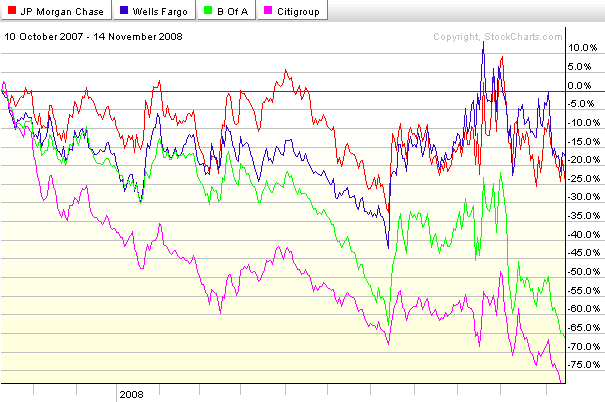
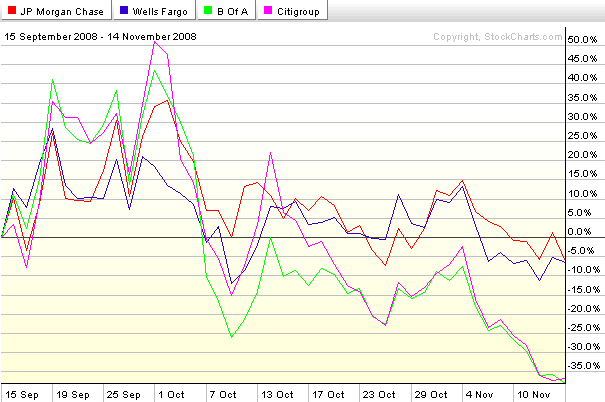
The events of 2008 have completely reshaped the landscape of the U.S. commercial banking industry. At this point it looks as if four major banks will emerge as the dominant players: two relatively strong ones; and two that face a more challenging competitive environment. Here the charts identify the players nicely. From the peak of October 2007, Wells Fargo (WFC) and JPMorgan Chase (JPM) have each fallen about 20%, less than one half of the drop in the financial sector ETF, XLF. At the other end of the spectrum are Bank of America (BAC) and Citigroup (C), each of which has seen their stock drop at least 65% during this period. See the top chart for details. Refocus to the period since the failure of Bear Stearns (bottom chart) and the pattern is even more dramatic, with WFC and JPM each down a little more than 5% while BAC and C are down over 35%.

XLF made a new low of 11.70 on Thursday and is trading at about 12.00 as I type this. If XLF and the large commercial banks are not able to scrape out a bottom, then this market will not be able to sustain any rally. Better yet, add XHB (homebuilders) and XLY (consumer discretionary sector) to that list. A sustainable rally will require the participation of XLF, XHB, and XLY.

[source: StockCharts]

Tuesday, April 15, 2008

Financials Testing Critical Support Level

This morning, State Street (STT) reported a $3.2 billion loss on its investment portfolio and an additional $2.5 billion loss on conduits, then was placed on Ratings Watch Negative by Fitch Ratings, signaling that Fitch will review the company’s credit rating for a possible downgrade.

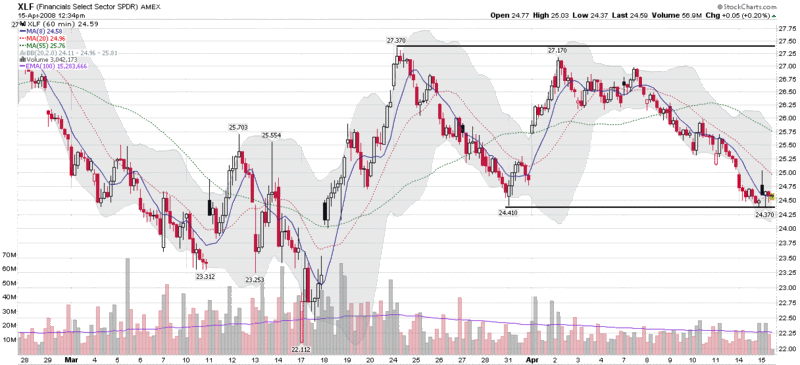
While the State Street news put a damper on financial stocks, XLF, the most widely followed ETF for the financial sector, is trading up as a write this. Earlier in the session, XLF tested an important March 31st low of 24.40 (see chart below) and has since bounced back. The 24.40 level is an important support level for the XLF and one to watch closely, particularly as tomorrow brings additional earnings reports from J.P. Morgan Chase (JPM) and Wells Fargo (WFC), as well as several smaller banks.

DISCLAIMER: "VIX®" is a trademark of Chicago Board Options Exchange, Incorporated. Chicago Board Options Exchange, Incorporated is not affiliated with this website or this website's owner's or operators. CBOE assumes no responsibility for the accuracy or completeness or any other aspect of any content posted on this website by its operator or any third party. All content on this site is provided for informational and entertainment purposes only and is not intended as advice to buy or sell any securities. Stocks are difficult to trade; options are even harder. When it comes to VIX derivatives, don't fall into the trap of thinking that just because you can ride a horse, you can ride an alligator. Please do your own homework and accept full responsibility for any investment decisions you make. No content on this site can be used for commercial purposes without the prior written permission of the author. Copyright © 2007-2023 Bill Luby. All rights reserved.
 
Web Analytics