Showing posts with label CHKP. Show all posts

Friday, March 30, 2012

Why Not Point Hedges?

When most people think of hedges, they think in broad terms like hedging an entire long equity portfolio with SPX/SPY puts or VIX calls or some similar product. The thinking is typically that it is better to have broad-based protection against a bear move in stocks and/or a spike in volatility than to build only one castle wall facing the direction in which an enemy attack is expected. More often than not, it is the unexpected that wreaks havoc on a portfolio, not the white swan that slowly morphs into ivory, then light gray, then…

I might as well say this up front: I hate hedges. I love the idea of hedges, but when it comes time to pay for one, they invariably come across as more expensive than even a reasonably effective market timing strategy. Of course, there are all kinds of hedges, from those that are limited to disaster protection insurance to those that are intended to counteract even the slightest nick to a portfolio. If I feel like I can get my hedges at a discount (Groupon, are you listening?) then I will gladly ante up and enjoy the safety net.

Now there are some out there who think that some of the risks to stocks, particularly domestic equities, are being exaggerated by most investors. Those who hold this opinion might be better served to avoid a broad-based hedge and think in terms of what I call a point hedge. Simply stated, a point hedge is a rifle approach to portfolio protection rather than a (full perimeter) castle wall approach.

Perhaps an example will help to illustrate the point hedge approach. Let’s assume that an investor thinks that the U.S. economy will do better than the doomsayers predict and even fulfill James Altucher’s prediction, which was far-fetched at the time, that the SPX will hit 1500 in relatively short order. If that’s the case, then should the rifle be aimed? Let’s further assume that this bullish investor is primarily concerned about a worsening conflict between Iran and Israel, Spanish fiscal issues starting to resemble the Greek crisis, a possible hard landing in China and the rise of cyberwarfare.

Rather than construct a broad-based hedge, it is possible to create a more cost-effective portfolio hedge by aggregating point hedges across all four areas of concern. For Iran and Israel, something like a long position in Brent crude oil (BNO) might do the trick. As far as Spain is concerned, purchases of puts in the country ETF (EWP) would be appropriate, but a more liquid and perhaps more targeted approach might be long puts in Spain’s largest bank, Banco Santander (STD). There are many alternative approaches in China, but certainly a short position in FXI or some long puts in that ETF is one approach worth investigating. Last but not least, cyberwarfare presents a different set of problems, but some of the firms where call purchases might be hedges against a spike in cyberwarfare are SAI, CHKP, FIRE, FTNT and SYMC.

Of course this is just one of many potential list of threats to the stock market and possible point hedges that might be used to counteract them. Even if you prefer the blanket coverage of a broad-based hedge, it is usually worth the time and effort to draw up a list of potential threats and stocks/ETPs that might be employed to counteract those threats or perhaps even provide some speculative gains.

On a related note, I realize that I have only periodically been applying the “hedging” label to my posts, so I reviewed quite a few posts in the archives and have begun to retroactively apply that label to those posts (such as several in the list below) which might be of particular interest to financial archeologists.

Related posts:

[graphic: Scaliger Castle, Sirmione, Italy – Library of Congress]

Disclosure(s): long FIRE at time of writing

Monday, October 13, 2008

Institutional Interest High in These Nine Large Caps

Stocks of all sizes and shapes are trading up today, but which ones will continue to do well if the market holds up?

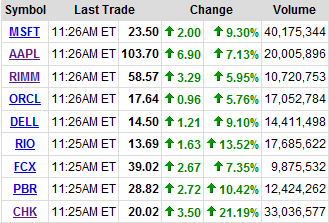
In the graphic to the right (courtesy of Yahoo) I highlight nine large cap stocks that appear to be the biggest targets of institutional interest not just today, but when the markets moved up in spurts last week too. Those that made the cut did so on the basis of several price factors and several volume factors. The list consists of five technology names (MSFT, AAPL, RIMM, ORCL, and DELL), two mining/metals stocks (RIO, FCX), and two energy stocks (PBR and CHK). Interestingly, two of the nine companies are based in Brazil.

At the very moment at least, these nine companies look to be at the top of the heap: quality stocks at attractive valuations, with considerable institutional interest. I would expect these names to continue to lead the way in subsequent bull moves.

Note that one company on this list may be somewhat of a special case. Chesapeake Energy (CHK) CEO Aubrey McClendon was forced to sell “substantially all” of his 33 million shares last week to meet a margin call. With that forced selling completed, the stock is bouncing back today.

Friday, September 21, 2007

Reflections on Investing Ten Years Ago

Yesterday I happened to be rummaging through some old files and came across my 1997 tax return. Fortunately, this had nothing to do with any communications with the IRS, but it got me to thinking about how my investing ‘evolution’ has three distinct long-term phases. Specifically, for the first ten years of my investment life, I dabbled in equities with mixed results at best, in much the same manner as Nicholas Darvas describes his early floundering in How I made $2,000,000 in the Stock Market.

Deciding that the time and effort was not worth the lackluster results, I pushed my savings into mutual funds for the next five years or so, again with fair to middling results. I got a little ornery and started chasing momentum funds like those from PBHG and Van Wagoner, but ultimately concluded that it might be possible for me to try to mimic what they were doing by buying individual stocks on my own.

[As a side note, Gary Pilgrim (PBHG) and Garrett Van Wagoner ended up having more than their share of difficulties, but their approach inspired me to aim higher than beating the S&P 500 by 1.0% point each year.]

To make a long story short(er), the third phase began in 1997 when I decided to go ‘all in’ on a portfolio consisting entirely of internet stocks. While that may not sound all that surprising with the benefit of hindsight, very few investors were buying any internet stocks at the time and frankly there were not that many choices out there. I reasoned (and yes there was some hope involved too) that if most of the technology changes that were being touted at the time came to fruition, it could be a once in a lifetime investment opportunity.

So…I made the type of decision in 1997 that many others would make in 1999 and early 2000. What happened?

In retrospect, I might have done better plowing my money into the Munder NetNet fund (now the Munder Internet fund), but instead, I picked five small and very speculative companies that I thought had a chance to be big home runs if things went my way. The first two companies I started buying up were content plays. If content was going to be king, I wanted to own the king makers. Both of my selections are still alive and kicking: BroadVision (BVSN) had a meteoric rise and then crashed back to earth, Icarus-style; Open Text (OTEX) has led a comparatively uneventful existence, growing slowly and steadily to its current $1.3 billion market cap. My third choice was CyberCash. I expected that someone like PayPal would eventually dominate the electronic payment business with the type of ‘increasing returns to scale’ (described by Brian Arthur, among others) as the industry standard, but alas it was not to be CyberCash, which eventually declared bankruptcy, had its assets sold to VeriSign, with the CyberCash intellectual property eventually ending up at PayPal via an acquisition. In the VoIP communications space, I bought VocalTec, a company that released what I believe was the first internet VoIP program. Now a $16 million also ran (still listed as VOCL, for the record), they even had something called – of all things – the IPhone out back in 1995. Sometimes you can recognize the pioneers by the arrows sticking out of their back... For whatever reason, I felt most confident in the fifth ‘internet stock’ I started buying. Check Point (CHKP) has been a leader in firewall and related security products in the ten years since I first started buying the stock. An Israeli company like VocalTec (for the record, Open Text is Canadian; BVSN was the only Silicon Valley company, as CYCH was headquartered in the Virginia suburbs, just outside of Washington D.C.), Check Point has grown to become a $5.4 billion company, but has always operated in the long shadow of a strong Cisco competitive threat, with this 1998 Check Point press release typical of that battle that has been fought.

So enough of the nostalgia. For those who may be interested, I did hold BVSN all the way to the 2000 top – and then some of the way down. I was out of the other four within a year. In retrospect, CHKP and OTEX turned out to be solid if unspectacular investments; CYCH and VOCL were the two dogs.

I’m not sure exactly what the lesson is here, if any. In 1998 I went on to pick a lot of winners in the internet space – and a lot of dogs. I have always been patient enough to let my winners run, but over the years I have continued to improve my ability to cut my losses quickly and protect my profits for those trades that make a big U-turn. If I had been fortunate enough to have read the likes of When to Sell, written by Justin Mamis in 1977, and It’s When You Sell that Counts, a 1991 classic from Donald Cassidy, I’m sure those early internet years would have been considerably more profitable. In the long run, each individual learning curve has different hurdles and a different timetable. The trick is to get a little smarter every day, even if your portfolio does not always reflect all newly acquired wisdom.

DISCLAIMER: "VIX®" is a trademark of Chicago Board Options Exchange, Incorporated. Chicago Board Options Exchange, Incorporated is not affiliated with this website or this website's owner's or operators. CBOE assumes no responsibility for the accuracy or completeness or any other aspect of any content posted on this website by its operator or any third party. All content on this site is provided for informational and entertainment purposes only and is not intended as advice to buy or sell any securities. Stocks are difficult to trade; options are even harder. When it comes to VIX derivatives, don't fall into the trap of thinking that just because you can ride a horse, you can ride an alligator. Please do your own homework and accept full responsibility for any investment decisions you make. No content on this site can be used for commercial purposes without the prior written permission of the author. Copyright © 2007-2023 Bill Luby. All rights reserved.
 
Web Analytics