Showing posts with label credit cards. Show all posts

Wednesday, May 13, 2009

Advanta and Charge Offs

In a story that I believe was underreported yesterday, the nation’s 11th largest credit card issuer, Advanta (ADVNB), announced it will be suspending all credit card charges on outstanding credit cards as of June 10th in order to “dramatically limit the company’s credit loss exposure and maximize its capital and its liquidity measures.”

As of March 31st, Advanta’s charge-off rate stood at 20%.

The credit card freeze will affect all of Advanta’s almost one million existing small business credit card accounts. While Advanta does not offer personal credit cards, all of the small business accounts are backed by personal guarantees. Given that approximately 25% of the outstanding balances on Advanta’s credit cards are from small businesses in California and Florida, there is a strong possibility that the rising charge-off rate is related to declining real estate values – and that many of Advanta’s small business accounts were sole proprietors using their card ostensibly as consumer credit cards, yet with higher credit lines.

Advanta’s announcement comes less than a week after two other credit card companies, American Express (AXP) and Capital One (COF), passed the government’s stress test and were deemed sufficiently capitalized so as not to be required to raise any additional capital.

Wednesday, April 8, 2009

Waiting for the Next Shoe to Drop?

There has been a lot of speculation about which corner of the economy is likely to implode next and start to write the next chapter in the current financial crisis. Credit card debt and commercial real estate are two of the most frequently cited potential culprits, but lately Eastern European banks have been under great stress, while credit default swaps for Romania, Bulgaria and Hungary have been on the rise.

I did not realize how strong the undercurrent of fear was until I ran Today’s Jump in the VIX on Monday evening. From the various public and private comments, it is clear that there is a strong contingent of veteran investors who anticipate not only that the next shoe will drop soon, but that the fallout will be at least as bad as what we experienced during the October-November peak of the crisis.

While I am not ruling out anything at this stage, I do not see the VIX spiking above 60 in the near future, nor do I even see a VIX above 50 as a likely scenario.

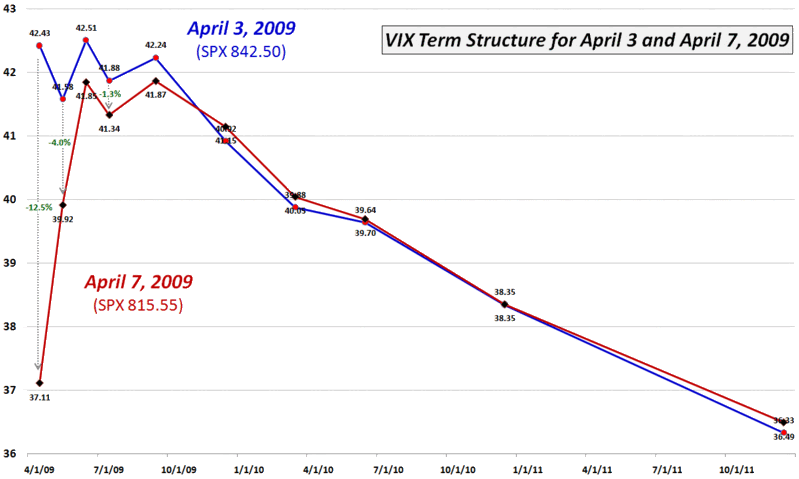
Last Friday, the SPX had its highest close since the 666.79 “devil’s bottom” low of March 6th. From Friday’s 842.50 close to Tuesday’s close of 815.55, the SPX fell 3.2%. During this same period, the cash VIX gained just 1.7%, moving up from 39.70 to 40.39. In the chart below, however, one can see that even thought the cash VIX rose, the volatility index for SPX options in April, May, June, July and September actually fell, with volatility for the April expiration showing a 12.5% drop in the VIX, May volatility dropping 4% and the June through September strikes show a volatility decrease on the order of 0.9%-1.6%. In other words, expectations for volatility – and presumably fear and uncertainty – for the balance of the year continue to point to improvement.

Of course, there is always a group of traders who get fearful when the VIX fails to measure what they believe is an appropriate level of fear. This group, whose concern I can sympathize with from time to time, will undoubtedly see an indifferent VIX as a reason to be even more concerned about the future.

For now at least, the VIX term structure points to increasing investor confidence in the markets and a decreasing concern about the possibility of gravity commingling ominously with oversized footwear.

[source: CBOE, VIXandMore]

Tuesday, May 27, 2008

Whither COF?

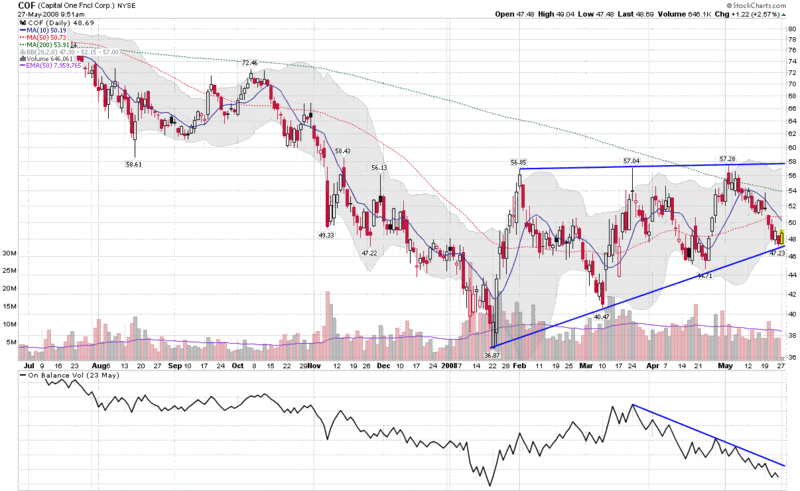
Ever since the onset of the credit crisis, it seemed like only a matter of time before problems in the area of home mortgages and HELOCs inevitably spread to credit cards. Given that Capital One Financial (COF) has dipped heavily into the subprime borrower market, it seems to reason that COF will be a large part of the collateral damage.

So far, COF has been able to keep charge offs at a manageable rate, one that was stable at 6.1% in March and April. This leveling off of the charge-offs in the most recent month prompted Goldman Sachs analyst Brian Foran to offer optimistically, “any sign that credit deterioration in U.S. card could be taking a breather is positive.”

COF’s stock is currently 30% above the January low and has traded in an ascending triangle, as the chart below shows. While the stock is up this morning, it is testing the bottom of the triangle pattern. Ominously, on balance volume shows a significant divergence from the price pattern, with at least three significant distribution days (down on above average volume) over the past four weeks.

While XLF, XBD, C and LEH are all important indicators of the health of the financial sector, keep an eye on COF to see how the credit crisis is affecting subprime credit card holders.

DISCLAIMER: "VIX®" is a trademark of Chicago Board Options Exchange, Incorporated. Chicago Board Options Exchange, Incorporated is not affiliated with this website or this website's owner's or operators. CBOE assumes no responsibility for the accuracy or completeness or any other aspect of any content posted on this website by its operator or any third party. All content on this site is provided for informational and entertainment purposes only and is not intended as advice to buy or sell any securities. Stocks are difficult to trade; options are even harder. When it comes to VIX derivatives, don't fall into the trap of thinking that just because you can ride a horse, you can ride an alligator. Please do your own homework and accept full responsibility for any investment decisions you make. No content on this site can be used for commercial purposes without the prior written permission of the author. Copyright © 2007-2023 Bill Luby. All rights reserved.
 
Web Analytics