Showing posts with label WorldCom. Show all posts

Thursday, August 18, 2011

Echo Volatility and Another VIX Double Top

Back in 2007, I wrote extensively about the phenomenon I dubbed echo volatility, in which large VIX spikes are frequently accompanied by a second spike of similar size in the month or so following the initial spike. Following the twin VIX spikes over 80 in 2008, I reprised this them in a post I titled The Significance of Double Tops in the VIX.

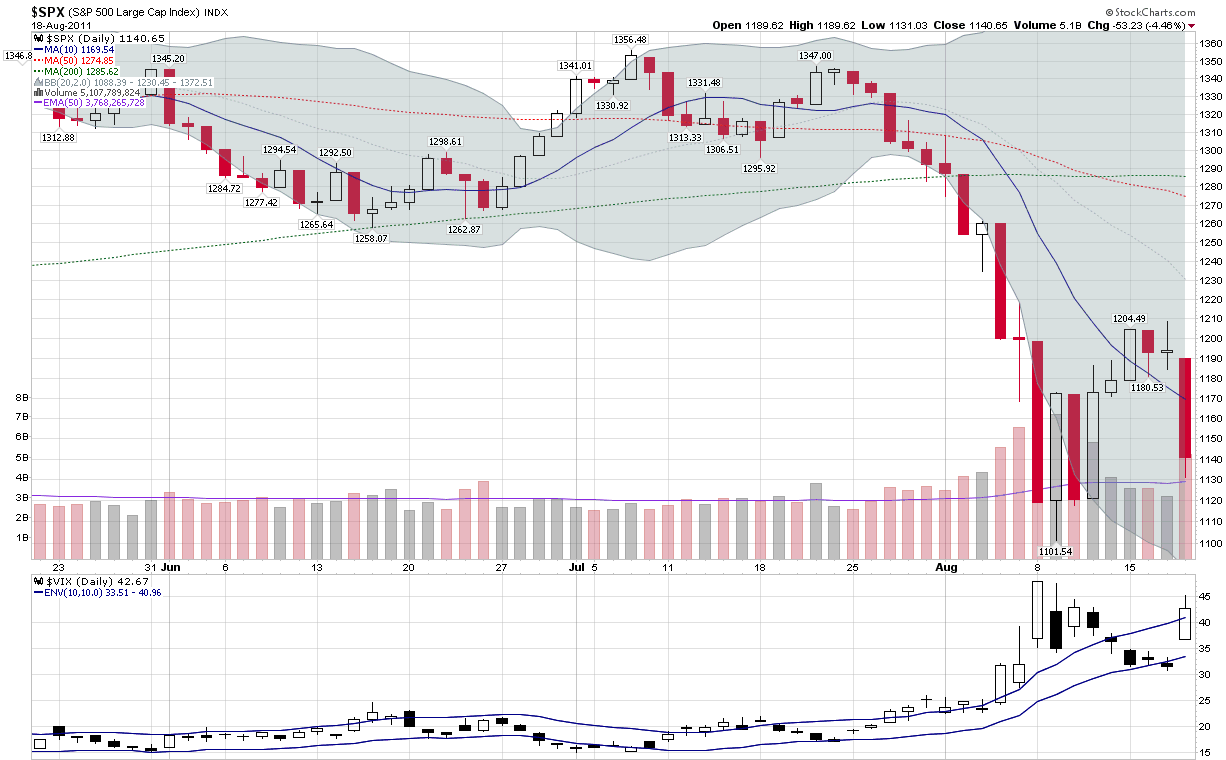
Lo and behold, here we are in another volatility storm and we have what looks like it was a VIX top of 48.00 on August 8th followed by a spike to 45.28 today – a nine day span between VIX spikes.
Of prior instances of VIX double tops, certainly the most dramatic comes from 2008, when the VIX hit an all-time high of 89.53, pulled back more than 45 points, then spiked all the way back up to 81.48 some 20 trading days later. The timing of these VIX spikes was eerily reminiscent of the 1998 Long-Term Capital Management fiasco, when the VIX hit 48.06 on September 11th, then exactly 20 days later hit a crisis high of 49.53.

In addition to those 20-day periods between VIX spikes, there is also precedent for a 9-day twin top going back to 2002, coinciding with the WorldCom bankruptcy filing. Here we saw a top of 48.46 on July 24th and a secondary spike to 45.21 nine days later.

In sum, of the top seven highest VIX spikes recorded to date, four of these have seen two separate spikes in which the VIX exceeded 45, with those spikes falling from 9 to 20 days apart.

Clearly there are fundamental factors that can trigger another VIX spike above the 45 level before the current volatility storm has passed, but if history is any guide, two is likely to be the lucky number.

Related posts:


[graphic: StockCharts.com]
Disclosure(s): short VIX at time of writing

Wednesday, October 28, 2009

VIX Spike of 35% in Four Days Is Short-Term Buy Signal

It has been awhile since I posted one of my VIX studies and given the recent spike in the VIX, today’s action seemed like a good excuse to revisit the idea of VIX spikes as contrarian bullish mean reversion buying opportunities.

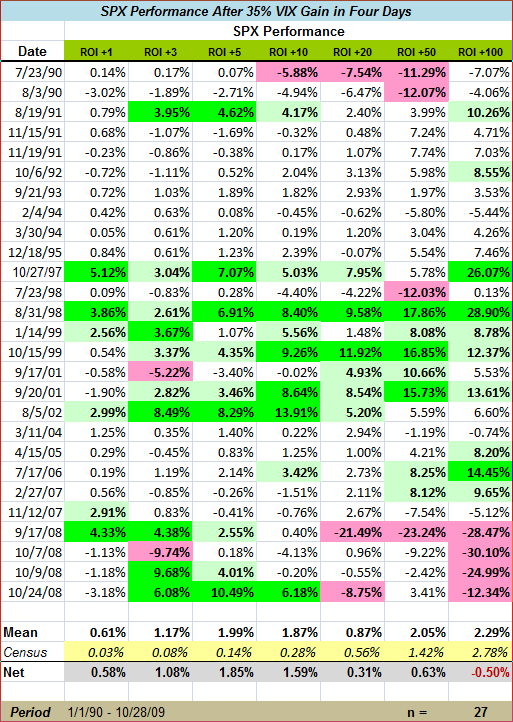
Today the VIX closed at 27.91, which is up 34.9% in the four trading days since Thursday’s close of 20.69. Over the course of the 20 year history of the VIX, the volatility index has posted close-to-close four day gains of 35% on 42 occasions. If you strip out the consecutive instances of +35% days, this leaves 27 instances in which the VIX crossed above +35% in four days. I have reproduced the full table of these 27 instances below for several reasons. First, the key takeaway is that from a timing perspective, a long SPX position entered after a 35% spike will generally perform best over the course of a five day time horizon. In the graphic below, the 27 instances average a five day gain of 1.99% vs. a typical five day SPX return of 0.14%, for a 1.85% net differential. While the net differential peaks at five days, it is apparent in just one day and persists for at least fifty trading days.

Not surprisingly, since we are talking about extremely volatile periods, quite a few of the returns are at the tail end of the distribution and are highlighted in green and red. In particular, this contrarian long strategy did an excellent job of timing the bounces off of the lows during the Asian financial crisis in 1997, the Russian financial crisis and Long-Term Capital Management crisis in 1998, the 9/11 World Trade Center attacks in 2001, as well as the technology bottom following the WorldCom bankruptcy filing in 2002.

In contrast to the excellent market timing above, it should also come as no surprise that the four long signals from September and October 2008 turned out to be disasters in the 20-100 day time frame. Over the course of a 3-10 day time horizon, however, these were excellent short-term trading opportunities from the long side. I do wish to point out, however, that if one strips out the last four rows of the tables, suddenly the 100 day time frame has a return of 6.86%, which is 2 ½ times that of the baseline (“census”) return. The obvious conclusion is that the VIX spike buy signal is quite reliable for the short-term, but not as reliable for over longer time frames. This is the key take away from the table and the reason I included the full data set. The secondary conclusion is that VIX spikes are generally good long setups as well, but here the risk is that it precedes a once in a generation or two meltdown that erases a decade or more of returns.

Finally, while it is nice to throw statistics at analogous historical situations, it is important to consider that all it takes is one rogue GDP number to throw a monkey wrench into an attractive set of statistics. Tomorrow should be interesting – and I expect the bulls will be putting a great deal of capital to work no matter how the GDP data falls.

For posts on related subjects, readers are encouraged to check out:

Disclosure: Short VIX at time of writing.

Wednesday, January 7, 2009

Satyam, Fraud, and the India VIX

Today’s announcement that Satyam (SAY), the Indian outsourcing giant, has been engaged in a massive accounting fraud over the course of several years sent Satyam down 78% in local trading and dragged the Bombay Sensex down 7.3%.

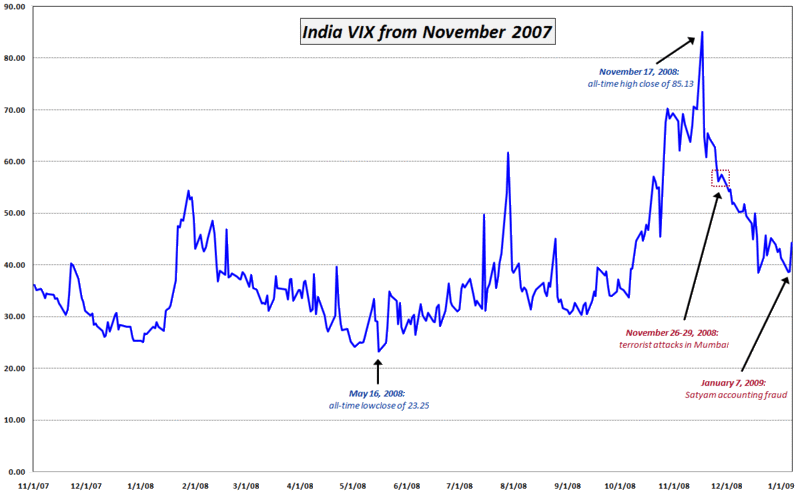
All things considered, I was once again surprised by the relatively small spike in the India VIX, which jumped 14.5% to close at 44.36.

In the chart below I have plotted the course of the India VIX since November 2007 (the index launched in April 2008, but historical data has been reconstructed extending back another six months.) I find it interesting that the scale of the India VIX is not that much different than that of its U.S. counterpart. I also find it interesting that concerns about the global financial crisis in October 2008 was responsible for the peak in the volatility index, while the Mumbai terrorist attacks the following month barely register as a blip on the chart.

It remains to be seen what sort of long-term fallout the Satyam fraud will have on Indian equities, but so far the reaction has to be considered a relatively muted one.

Keep in mind that after many failed attempts at a bottom in 2001 and 2002, the NASDAQ did not put in a bottom until just after the WorldCom bankruptcy filing.


[source: National Stock Exchange of India, VIX and More]

Sunday, December 7, 2008

The Significance of Double Tops in the VIX

The following is adapted from a subscriber newsletter segment that appeared in the November 26th newsletter.

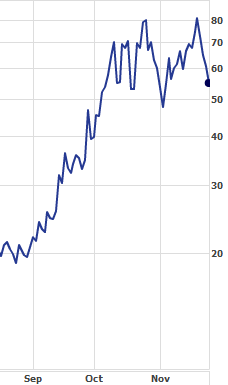
I have never seen any research on the subject of VIX double tops, but given the recent double top formation in the VIX, I thought this might be a good time to share some of my thinking on the subject. First, the chart at the right shows the recent VIX levels from mid-August to the present. The first spike in the double top comes on October 24th and the most recent spike comes on November 19th.
Double tops are fairly common in the 19 year history of VIX data and frequently coincide with extreme readings in the VIX. By contrast, VIX triple tops are relatively rare; and while single VIX spikes are common in more mundane market conditions, they are less likely to be found at VIX extremes than double tops.

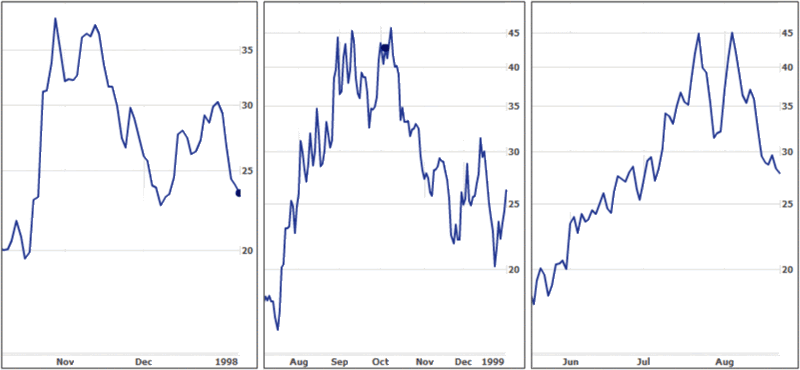
In fact, prior to this year, the three crises with the most extreme VIX readings were the 1997 Asian Financial Crisis, the 1998 Long-Term Capital Management Crisis, and the 2002 bottom of the technology bust that accompanied the WorldCom bankruptcy filing. In the graphs below, I have recorded the history of these VIX spikes. You can clearly see a double top pattern in the VIX in all three instances. Interestingly in each instance, the spikes were separated by approximately 2-3 weeks and signaled major turning points in the markets.

Recent events have shown that extrapolating from past chart patterns to the current market is fraught with danger, but I would argue that the presence of a VIX double top reinforces the case that the recent stock market bottom will prove to be an important market inflection point.

[source: Yahoo, VIX and More]

Wednesday, September 24, 2008

Could 30 Be a New VIX Floor?

Yesterday a reader asked, “Have we put in a base for the VIX above 30?”

My response began as follows:

“I count five separate instances (clusters) of the VIX hitting 40 since 1990. In only one of those (1997) did the VIX not hit 40 again shortly thereafter. For the other four, we saw 5, 7, 13, and 21 subsequent days in which the VIX made it into the 40s again. Given the magnitude of the current difficulties, I would be surprised if we do not see at least one more spike into the 40s.

As for a new floor in the VIX, 30 is on the high side, but not unprecedented. We have had several instances in the past where the VIX spent two full months almost exclusively at 30 or above.”

To elaborate a little, starting in August 1998, during the height of the Long-Term Capital Management crisis, the VIX closed over 30 each day for more than two consecutive months. This feat was matched again four years later in August 2002, following the WorldCom bankruptcy and the ultimate bottoming of the dot com crash.

For what it is worth, as of last night the VIX has closed above 30 for seven consecutive days. A two month stretch of 30+ VIX closes would take us out to mid-November.

Finally, to complete my response about the possibility of a new floor of 30 for the VIX, I noted:

“On the other hand, if the country can get behind a bailout plan that shows some creativity and potential, then I would not be surprised to see volatility to slip back to the mid-20s shortly thereafter.

...at least until we dive into the housing, jobs, and consumer spending can of worms.”

Wednesday, August 22, 2007

Which Gravity?

In my seemingly never ending quest to litter this space with obscure and occasionally relevant VIX trivia, I have today come across some numbers that I find particularly interesting.

First, let me point out that the VWSI is currently back to reading an even zero, with neither a bullish nor bearish bias. Part of the reason for this neutral reading is the current deadlock in the gravitational tug of war between short-term and long-term mean reversion. Not only that, but in the 17 year history of the VIX, the current 15% under the 10 day SMA and 43% over the 100 day SMA is the largest ever divergence between these two indicators. The question, of course, is whether the gravitational pull of the 10 day SMA (not pictured) will win out over that of the 100 day SMA – or even whether one mean reversion magnet will get the upper hand going forward.

For market historians, there are two instances of possible historical precedent which may be of interest.
In the end of July 2002, we had the largest previous divergence, with the VIX 17% under the 10 day SMA and 32% over the 100 day SMA. This set of circumstances followed the WorldCom bankruptcy filing and came close to signaling the bottom of the 2000-2002 bear market. In fact, in the days leading up to this divergence, the VIX fluctuated wildly to a peak of 48, then dropped to 31 just three days later. Within a week following the maximum divergence, the VIX was back over 45 again; and it remained elevated over the course of the next two months as the markets finally confirmed a bottom.

There is some similar historical precedent in the wake of 9/11, during which period the VIX hit 49, then dropped to 31 five days later, resulting in a VIX 16% under the 10 day SMA and 33% over the 100 day SMA. What followed was a temporary market bottom and VIX readings that went sideways for about five weeks, then began to subside for about nine months, before the July 2002 craziness noted above kicked in.

I am not sure what to conclude, if anything, about the historic divergence at present, other than it is the almost inevitable residue of an unprecedented VIX spike. In a few weeks we will all know whether the liquidity/credit crunch has swallowed up one or more of our trusted financial institutions or, as is usually the case, if investor fears just got a little too far ahead of the reality.

DISCLAIMER: "VIX®" is a trademark of Chicago Board Options Exchange, Incorporated. Chicago Board Options Exchange, Incorporated is not affiliated with this website or this website's owner's or operators. CBOE assumes no responsibility for the accuracy or completeness or any other aspect of any content posted on this website by its operator or any third party. All content on this site is provided for informational and entertainment purposes only and is not intended as advice to buy or sell any securities. Stocks are difficult to trade; options are even harder. When it comes to VIX derivatives, don't fall into the trap of thinking that just because you can ride a horse, you can ride an alligator. Please do your own homework and accept full responsibility for any investment decisions you make. No content on this site can be used for commercial purposes without the prior written permission of the author. Copyright © 2007-2023 Bill Luby. All rights reserved.
 
Web Analytics