Showing posts with label Peak Oil. Show all posts

Friday, November 13, 2009

Peak Oil, IEA Whistleblower Update, etc.

I have been traveling and have had limited connectivity for the past few days, but I note that the Peak Oil post has generated a fair amount of interest and that others are running with the story, notably:

Tuesday, November 10, 2009

IEA Whistleblower Says Oil Production Capacity Deliberately Overstated

I am neither an alarmist nor a conspiracy theorist, but I have been extremely concerned about Peak Oil long before I took on the VIX a pet project. Now that I occasionally find myself as an unofficial source of all things VIX and volatility, it seems I am also perpetually on the lookout for storm clouds on the horizon.

Where will the next big threat come from? commercial real estate? failed Treasury auctions? the dollar? Pakistan?

According to The Guardian, a sure bet is Peak Oil. In Key Oil Figures Were Distorted by U.S. Pressure, Says Whistleblower, Terry Macalister reports that the International Energy Agency (IEA) has been deliberately publishing overly optimistic oil production capacity data, largely due to arm twisting by the U.S. government. Macalister quotes two different unnamed IEA sources, including one who assesses the situation as follows:

“The IEA in 2005 was predicting oil supplies could rise as high as 120m barrels a day by 2030 although it was forced to reduce this gradually to 116m and then 105m last year. The 120m figure always was nonsense but even today's number is much higher than can be justified and the IEA knows this. Many inside the organization believe that maintaining oil supplies at even 90m to 95m barrels a day would be impossible but there are fears that panic could spread on the financial markets if the figures were brought down further. And the Americans fear the end of oil supremacy because it would threaten their power over access to oil resources.”

A second IEA source attributes much of the unrealistic data to a culture in which it was “imperative not to anger the Americans.” Speaking about the current state of oil production, he added, “We have [already] entered the 'peak oil' zone. I think that the situation is really bad.”

Now I take everything I read with a grain of salt, but I think the important question here is whether the quotes from above are the complete truth or merely mostly truthful. If I were looking to predict future disaster scenarios, Peak Oil would be near the top of my list. The question here is not if, but when – and what sort of ugly political and economic consequences will be intertwined with Peak Oil.

The financial crisis may have temporarily postponed the Peak Oil train wreck, but a slow-motion train wreck is hardly an improvement – and often turns out to be more painful to watch.

For some related posts, readers are encouraged to check out:

Wednesday, May 21, 2008

Gold vs. Oil

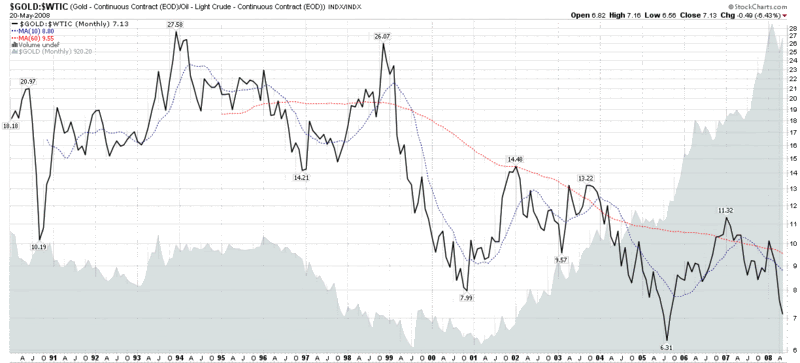
Peak Oil or not, crude has had an incredible run as of late. If you have any doubt about how sharp the move has been, check out Tim Knight’s Elliott wave count and chart at The Slope of Hope.

As the chart below shows, gold has had quite a run too (see the area chart), but lately oil has been outperforming gold. One way to interpret this ratio chart is to think of what an ounce of gold would cost if it were priced in barrels of oil. As anyone who has been to Dubai lately can tell you, it is taking less and less oil to buy an equivalent amount of gold these days.

There was a time when a house was considered to be one of the best hedges against inflation. Clearly that is not the case at the moment – at least in the US. Gold has historically been an even better inflationary hedge, but lately oil has outpaced gold in that area. The oil trade is very crowded at the moment and when oil turns down, there will still be many who are seeking alternative hedges against inflation. Don’t be surprised if a lot of that oil money flows into gold and sends the gold to oil ratio back toward historical norms.

Monday, June 18, 2007

The Risk Library

Two weeks ago I offered up “Ten Anecdotal/Historical Book Ideas for Investors” on the premise that humans have a tendency to learn and retain more valuable concepts when the learning process is enjoyable.

This list is quite different. Risk is something that the novice trader/investor invariably fails to think about enough and properly address in their trading methodology. Interestingly, risk management is often the Achilles heel of more experienced traders who know better, but also fail to attend to with sufficient rigor.

With this in mind, I offer up some favorites from my personal library to help all traders think about risk and act to limit the risks inherent in their trading strategies, ordered roughly from the most abstract to the most prescriptive, which I often find is an excellent way to tackle any unfamiliar subject:

Against the Gods (Peter Bernstein) – A high level survey of the history of risk from the perspective of the advance of civilization. A relatively quick read that should inspire the desire to take a closer look at risk vis-à-vis investments. 

The (Mis)Behavior of Markets (Benoit Mandelbrot) – A fun and mind-expanding stew of financial risk, fractals and chaos theory. A great thought starter and surprisingly easy for non-math/physics scholars to breeze through.

Fooled By Randomness (Nassim Taleb) and The Black Swan (Nassim Taleb) – I suggest you try these in chronological order, starting with Fooled By Randomness. If Bernstein and Mandelbrot offer up two solid thought starters, then Taleb is a master of throwing gasoline on the fire. Deftly written in his own idiosyncratic narrative, Taleb’s books are bursting at the seams with ideas and ground zero is risk.

Choices, Values, and Frames (Daniel Kahneman and Amos Tversky) – Behavioral finance is a subject that is still gaining traction, but the sooner you steep your thinking in the ideas of the discipline’s founding fathers, Kahneman and Tversky, the better off you will be. This particular book is a collection of essays that you can read through at your own pace.

Manias, Panics, and Crashes (Charles Kindelberger) and/or Devil Take the Hindmost (Edward Chancellor) – Kindleberger offers a dense but informative history, while Chancellor wins out in terms of readability. Each is an excellent account of the history of speculation and market excesses; picking one of the two would probably suffice. Note that Charles MacKay’s Extraordinary Popular Delusions and the Madness of Crowds should also probably be on this historical menu, but I have not yet read it.

With Fortune’s Formula (William Poundstone), this list passes over from the largely theoretical into the prescriptive realm. This is a fun read on the Kelly criterion, set to a backdrop of blackjack and casino gambling.

A Thousand Barrels a Second (Peter Tertzakian) and/or The Oil Factor (Stephen Leeb) – There are many books out there that discuss the merits of Peak Oil. I have only read a few of them, but Tertzakian’s treatment is by far my favorite and certainly one of the more objective ones. Leeb’s book probably created a larger stir (as did his The Coming Economic Collapse, which strikes me as little more than a hastily assembled slight update of his previous book), but it covers most of the important points in much smaller bites. Every investor, Peak Oil proponent or otherwise, needs to take a close look at this subject and be prepared for how a number of oil-related scenarios may play out over the remainder of their investment time horizon.

Financial Shenanigans (Howard Schilit) – The subtitle of the book, How to Detect Accounting Gimmicks & Fraud in Financial Reports is exactly what this book is all about. Here is a fundamental approach that addresses what to look for, with an excellent treatment by Schilit. It is up to the reader to determine whether these companies should merely be avoided or whether they might also be short candidates.

How to Make Money Selling Stocks Short (William O’Neil and Gil Morales) – This is another prescriptive book and it relies entirely on a couple of basic technical analysis concepts. Even with that shortcoming, I think the true value of the book is that it will help you to actively look for short opportunities and avoid the confirmation bias that long-only approaches can sometimes succumb to. For example, if stock chart is screaming “buy” at you, would it be a “sell” if you turned the chart upside down?

When to Sell (Justin Mamis) and/or It’s When You Sell that Counts (Donald Cassidy) – While it is easy to find books on how to buy stocks, good luck finding an entire book devoted to the topic of selling them. Mamis and Cassidy are the only two books of this kind I have encountered and fortunately each offers an excellent treatment of the subject. I am slightly partial to Mamis here, but since most of us make or lose a lot more money managing existing positions than seeking better entries, my suggestion is to try both of them.

Trading Risk (Kenneth Grant) – This book is the only one I know of that offers highly detailed advice about how to evaluate the various types of risk in your holdings and take action to mitigate those risks. If I could, I would make it required reading for any newcomer to the investment world.

DISCLAIMER: "VIX®" is a trademark of Chicago Board Options Exchange, Incorporated. Chicago Board Options Exchange, Incorporated is not affiliated with this website or this website's owner's or operators. CBOE assumes no responsibility for the accuracy or completeness or any other aspect of any content posted on this website by its operator or any third party. All content on this site is provided for informational and entertainment purposes only and is not intended as advice to buy or sell any securities. Stocks are difficult to trade; options are even harder. When it comes to VIX derivatives, don't fall into the trap of thinking that just because you can ride a horse, you can ride an alligator. Please do your own homework and accept full responsibility for any investment decisions you make. No content on this site can be used for commercial purposes without the prior written permission of the author. Copyright © 2007-2023 Bill Luby. All rights reserved.
 
Web Analytics