Showing posts with label AAVX. Show all posts

Monday, September 10, 2012

Updates to VIX ETP Landscape: Add VIXH; Drop 12 UBS Products

Two thirds of 2012 passed before we saw the first new VIX-based exchange-traded product and it turned out to be an interesting one: the First Trust CBOE S&P 500 Tail Hedge Fund ETF (VIXH), which was introduced at the end of August. VIXH is essentially a portfolio consisting of 99-100% of SPY, augmented by a dynamic allocation of 0-1% of VIX options, with the amount of options determined by the level of the VIX at the beginning of each VIX expiration cycle. This is the first VIX-based ETP to included VIX options among its holdings and it is notable that this product bucks the recent trend and is an ETF instead of an ETN. There are other features of VIXH worth discussing and I will discuss these in future posts.

As the VIX ETP product space expands a bit, it also contracts a great deal, as UBS has elected to close 12 of its ETRACS ETNs, effective tomorrow, September 11, 2012. These UBS products failed to gain sufficient volume and assets to make these viable over the long haul, but when AAVX retires, it will do so with the best VIX ETP track record of all-time. This product was launched on September 8, 2011 and is up about 120% in the year plus since it was launched. [See ETRACS Volatility ETPs for the full list of ETPs that will be closed.]

The graphic below is my periodic update of the VIX exchange-traded products (ETP) landscape, using the y-axis to denote leverage and the x-axis to indicate target maturity. In addition to the explanatory notes in the key at the bottom, it is worth noting that I use font color to distinguish between ETFs (black) and ETNs (blue). Also, I have used a parenthetical one letter code to identify the issuer: B = Barclays; C = Citibank; F = First Trust; P = ProShares; U = UBS; and V = VelocityShares.

[As an aside, regular posting should resume again this week…]

Related posts:

Disclosure(s): long VIX at time of writing

Tuesday, February 28, 2012

ETRACS Volatility ETPs

While the likes of TVIX and UVXY have become overnight sensations during the last few weeks, one group of VIX exchange-traded products (ETPs) that continues to toil in relative obscurity is the dozen ETRACS VIX ETN that UBS launched in September 2011.

The ETRACS products are simple in their conception: they are based on the VIX futures and include both long and inverse products with target weighted average maturities of 1 month, 2 months, 3 months, 4 months, 5 months and 6 months. The tickers are straightforward as well: VXAA for the 1month long product, with AAVX for the 1 month inverse product; VXBB for the 2 month long product, with BBVX for the 2 month inverse product; etc.

In essence, the ETRACS volatility products have the potential to allow investors in a standard brokerage account the ability to be long or short almost any portion of the VIX futures curve without having to trade in a futures account and deal with the additional regulatory, margin and other complexities of maintaining a futures account.

In practice, the ETRACS products have found a limited audience. The total volume across all twelve produces was less than 10,000 shares today and unfortunately that is a typical trading day for the ETRACS suite.

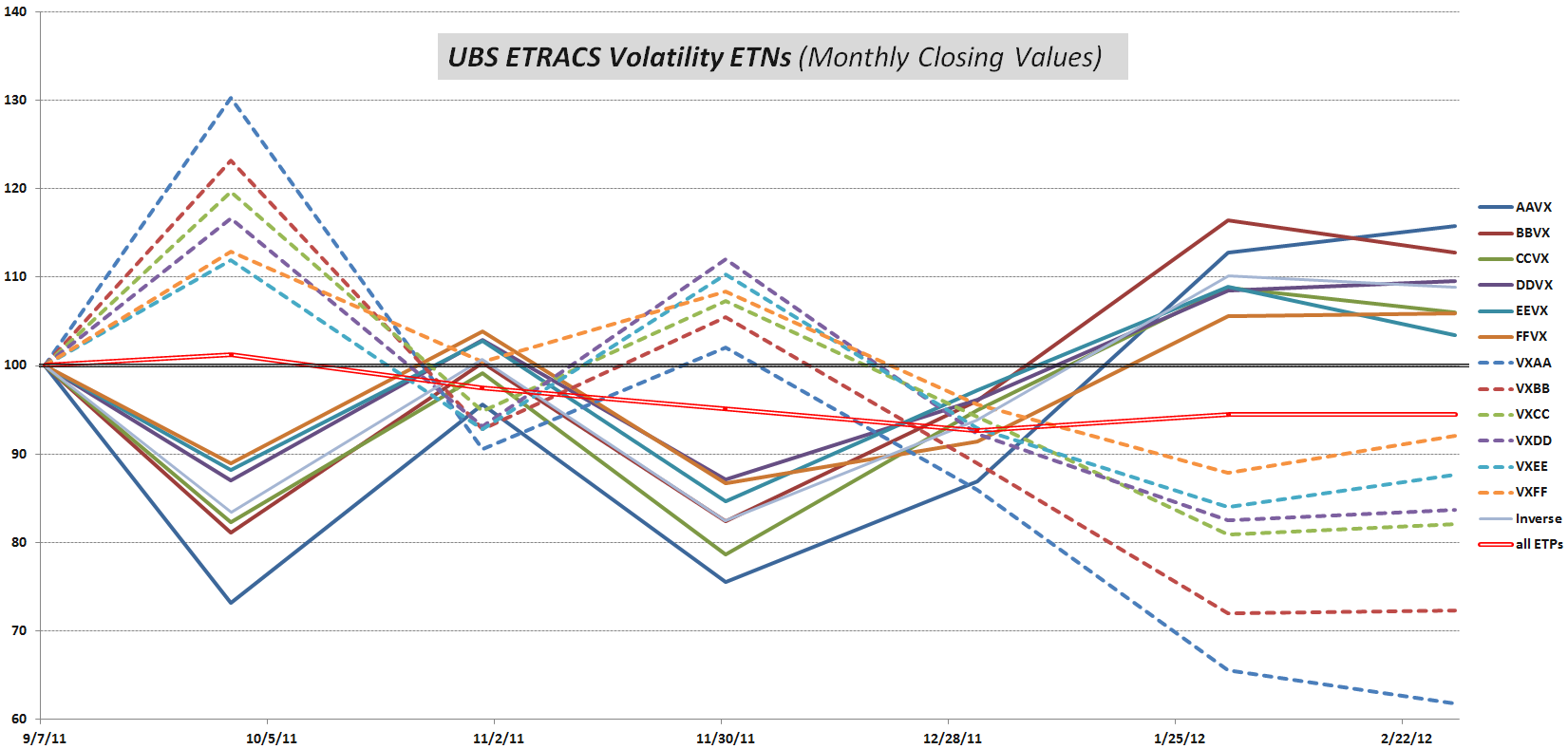
Even if you elect not to trade any of the ETRACS volatility ETPs, studying their price movements can yield a fair amount of insight. All were first traded on September 8, when the VIX was trading at about 34. In the intervening period, all the long VIX products have lost ground (from -8% to -38%, depending upon target maturity), while all the inverse products have made money (from +5.9% to +15.8%, depending upon target maturity), as shown in the graphic below. Due largely to the ravages of term structure and negative roll yield, the losses have been larger than the gains and the mean performance across all twelve ETPs (solid bright red line) has been a loss of 5.6% during the five months and twenty days since these products were launched.

Should these ETRACS product turn out to have a long life (and they will likely need a lot more fans if this is going to be the case), then they will paint a fascinating picture of the evolving VIX term structure and the consequences of negative and positive roll yield. As it is now, even the short-lived mirror image lines tell a story that is worth paying attention to.

Related posts:

[source(s): Yahoo]

Disclosure(s): long BBVX; short TVIX and UVXY at time of writing

DISCLAIMER: "VIX®" is a trademark of Chicago Board Options Exchange, Incorporated. Chicago Board Options Exchange, Incorporated is not affiliated with this website or this website's owner's or operators. CBOE assumes no responsibility for the accuracy or completeness or any other aspect of any content posted on this website by its operator or any third party. All content on this site is provided for informational and entertainment purposes only and is not intended as advice to buy or sell any securities. Stocks are difficult to trade; options are even harder. When it comes to VIX derivatives, don't fall into the trap of thinking that just because you can ride a horse, you can ride an alligator. Please do your own homework and accept full responsibility for any investment decisions you make. No content on this site can be used for commercial purposes without the prior written permission of the author. Copyright © 2007-2023 Bill Luby. All rights reserved.
 
Web Analytics