Chart of the Week: ISM Plummets
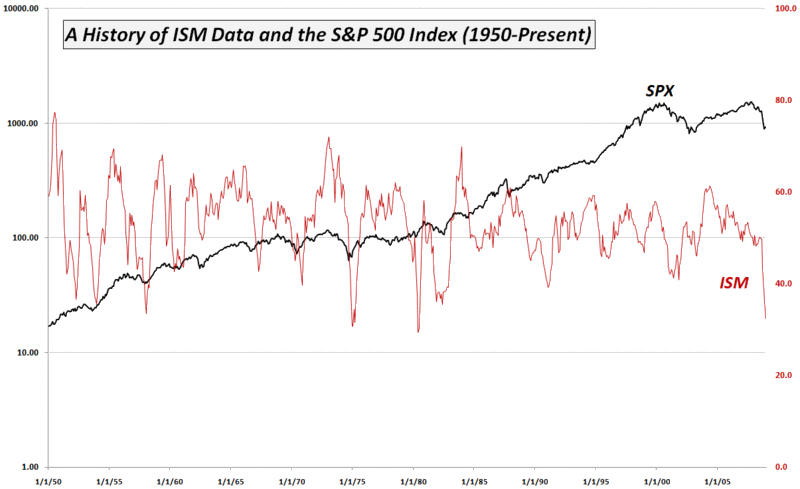
The stock market may have shaken off the December ISM’s 32.4 number, but investors should keep in mind that in the 61 year history of the ISM index, only three previous recessions (1949, 1974-75 and 1980) have seen lower ISM numbers. Even more concerning than the headline manufacturing index number was the report that new orders are now lower than they have been at any time in the 60 year history of the data.
The chart of the week below captures in ISM and the SPX from 1950. In addition to the obvious cliff dive that began in September, I find it interesting that the manufacturing index has been slowly trending down since hitting a high in May 2004.
As an aside, in 2009 I intend to devote more space on the blog to macroeconomic issues (particularly housing, manufacturing and consumer spending), as well global events that shape the geopolitical and economic landscape.
[source: Institute for Supply Management, VIX and More]




12 comments:
Looking at the chart, the ISM index seems to have the property of recovering very rapidly from its lows.
Also, it does not seem to be a good leading indictor for what its going to happen to the SPX in the future?
Instead of comparing 2 charts that are not graphically represented the same, try comparing them in the same light.
Why not show the change of the SPX INDEPENDANT of the historical movement? Then you would see the absolute movement of the SPX just as you are showing with the ISM. Otherwise, the comparisons are not relatively correlative.
cheers for 2009 Bill, and good idea to add a broader focus to the blog.
Great chart, but as the first comment notes, the ISM index does not appear to do a good job in predicting SPX weakness.
I took a closer look at the relationship between bottoms in ISM and SPX in this post. In general, ISM doesn't seem to predict SPX, but in some cases, the manufacturing index does lead.
Great to see you expand your content.
Anon 1,
I had the same thought at first, before I realized that in 1981-82 the ISM spent 13 months in a row under 40.0.
Special K,
First, thanks for the link and the excellent post. Your blog is off to a good start.
The new orders component of the ISM is similar to the new orders component from the Preliminary Report on Manufacturers' Shipments, Inventories, and Orders that is one of the 'official' leading indicators tracked by the conference board.
The SPX is also one of the ten leading indicators. Measures of manufacturing activity are generally considered to be coincident indicators than only tell you how well (or poorly) the economy is doing at the time the data were gathered.
Cheers,
-Bill
Thanks for the additional information on ISM Bill, and the encouragement.
For most up-to-date news you have to go to see web and on internet I
found this website as a best web site for newest updates.
Visit my homepage - Borse Gucci Ufficiale
Magnificent goods from you, man. I have understand your stuff previous to and you are
just extremely fantastic. I really like what you've acquired here, really like what you're stating and the way in which you say
it. You make it enjoyable and you still
care for to keep it smart. I can't wait to read far more from you. This is actually a great website.
my site - Abercrombie
Write more, thats all I have to say. Literally,
it seems as though you relied on the video to make your point.
You clearly know what youre talking about, why throw away
your intelligence on just posting videos to your weblog when you could be giving us
something enlightening to read?
Here is my blog post: Louis Vuitton Outlet
Hi are using Wordpress for your site platform? I'm new to the blog world but I'm trying to get started and create my own.
Do you require any html coding knowledge to make your own
blog? Any help would be greatly appreciated!
Also visit my web site :: http://wiki.gilug.org/index.php/Usuari:RamonitaW
Hello, of course this post is in fact fastidious and I have learned lot of things from it about blogging.
thanks.
Also visit my webpage :: extra resources
Greetings from Los angeles! I'm bored at work so I decided to check out your blog on my iphone during lunch break. I love the knowledge you present here and can't wait to take a look
when I get home. I'm surprised at how quick your blog loaded on my cell phone .. I'm not
even using WIFI, just 3G .. Anyways, fantastic blog!
Look into my webpage - Sac Louis Vuitton
Post a Comment