Showing posts with label Friday. Show all posts

Friday, February 8, 2008

TGIF or OSIF?

It’s Friday, which means that if you have long positions, you are likely to be calculating the risks of holding those positions over the weekend and imagining what sort of headlines might greet you and your portfolio on Monday morning.

There is so much headline risk – or at least perceived headline risk – out there right now that I suspect it will be very difficult for the bulls to put together a sustained rally today. That being said, each Friday going forward is going to be a litmus test of sorts for the bulls, particularly next Friday, which falls just before a three day weekend in the US.

Though this is only the sixth Friday of 2008 and far from enough data points to begin talking about statistical significance and confidence intervals, the first five Fridays of the year have a mean loss of 1.30%, while Mondays through Thursdays have only seen an average drop of 0.37% over the first 21 non-Friday sessions of the year.

In simplistic terms, I do not think that the bulls can make a credible case for a market turnaround as long as they are unwilling to bid prices up in advance of the weekend. When Fridays start looking up and weekend risks start looking palatable, this may be one of the signs that we have put in a bottom.

Friday, April 27, 2007

The VIX on Mondays After Options Expiration

A reader asked me what usually happens to the VIX on the Monday following options expiration.

The short answer is that since 1990, the VIX has risen an average of 2.9% on the Monday after options expiration. Looking at all five days of the week, the VIX has posted a mean daily increase of 0.16% since 1990. If you back out those Mondays following options expiration, however, the remaining increase is a mere 0.02% per day, meaning that these post-expiration Mondays have accounted for almost all of the cumulative upside movement in the VIX over the past 17 years.

For what it’s worth, I also looked at the subset of Mondays following quadruple witching days and determined that those results were statistically identical to the other post-expiration Mondays.

One statistic that I found particularly interesting is that 80% of the VIX gains on typical post-expiration Mondays and 90% of the gains following quadruple witching expirations are, on average, reversed in the course of the next three days. So the next time you see a post-expiration bump in the VIX, expect that by the following Thursday almost all of the move will have evaporated.

For more on the VIX action on Mondays, Fridays, and during the options expiration cycle, click on the appropriate label links at the bottom of this entry.

Wednesday, April 25, 2007

The Unusual VIX Activity of April 23rd

A reader asked for my opinion on the unusual action in the VIX on Monday, April 23rd in which the VIX was up 8% while the SPX was down only 0.2%. If you follow the link above, you can see that my relatively unconsidered response pointed at three potential factors which might have had a larger effect on the VIX than the SPX.

Two days later, I am going to stick to my initial reaction, with a couple of minor elaborations. The one additional factor that looms much larger in retrospect is the fear associated with the real estate market crashing in Spain, as well as potential spillover into the banking sector and into other geographies. I wish I had a better explanation, but I don’t. I am posting my thoughts here in hopes that some readers can weigh in with their theories.

  1. The Friday to Monday VIX problem is "a collision of the trading week and the calendar week" in which trading and calendar time is synchronized during the trading week, but becomes uncoupled on weekends and holidays. On Monday, time is re-synchronized and volatility spikes to mark the event.

    This phenomenon is described by Adam Warner in a comment on this blog when I was first grappling with this issue; you can also check out a related thread at Elite Trader. Better yet, read Alan Lightman’s delightful Einstein’s Dreams to get an appreciation for how time warps and bends its way through our lives.

    For an academic perspective on the Friday to Monday VIX phenomenon, I refer you to A Tale of Two Indices by Peter Carr and Liuren Wu, whose weekday effects analysis is on page 10. A quick eyeball of the charts shows that the typical price jump from Friday to Monday is in the 2.0 to 2.2% range.

  2. A much less important factor, but one I still think is worth pointing out, is that volatility usually rises the week after options expiration. I discussed this phenomenon early on in the life of the blog, but should return to this theme for follow-up at some point.

  3. My guess is that with a combination of VIX implied volatility having dropped dramatically during the past two weeks and the broader markets on an impressive winning streak, several indicators were flashing overbought signals and the VIX looked like cheap portfolio insurance once again.

Some quick back of the envelope analysis give us 2% for the Friday to Monday calendar problem, another 2% for the 0.23% drop in the SPX (I have the VIX at a current beta of -8.34, so 0.23% * 8.34 ≈ 2%) and perhaps 0.5% (a SWAG) for the week after options expiration week and I can account for about a 4.5% spike in the VIX for Monday. That leaves another 3.5% to be accounted for by Spanish real estate, cheap portfolio insurance and other factors.

If nothing else, perhaps Monday’s action will provide Bill Rempel with more fodder for his “error term” analysis.

Monday, February 12, 2007

The VIX on Mondays and Fridays

It probably comes as no surprise to anyone who takes options seriously that the VIX is most likely to make a big move up or down on either Monday or Friday, but did you realize that the Friday moves are mostly up and the Monday moves are mostly down?

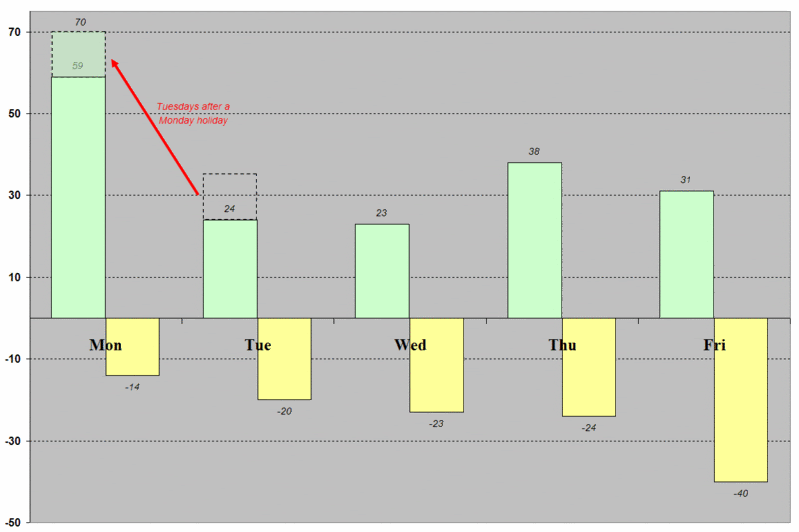
Today’s Excel cut and paste shows all the one day moves in the VIX of 10% or more since 1990. For starters, 61% of these have been up, while 39% have been to the down side. Monday sees by far the most VIX spikes up. If you add the 11 moves of 10% or more that happened on Tuesdays when the markets were closed for a Monday holiday (i.e., those indicated by the red arrow and dashed box), the pattern of a large plunge on the first trading day of the week becomes even more predominant, with 70 sessions of a 10% or greater VIX move up (shown in green) versus only 14 sessions with a 10% move down. On balance, Tuesdays and Wednesdays are relatively light in terms of large VIX moves to the upside, with activity picking up somewhat on Thursdays and Fridays.

Looking at 10% VIX moves down, the trend rides a slow and steady weekday crest, starting from a Monday low and moving up a little each day, with Friday the big winner in the spike down sweepstakes.

I am not yet ready to speculate on the causes of the Friday volatility drops and the Monday and post-holiday Tuesday VIX surges, other than to point out that even following 9/11, when the country appeared to hold its collective breath over the weekend, this pattern seemed to hold.

I will note that in the past couple of years, some of the patterns in the weekday trends may have weakened a little, but for the most part, they have held up in periods when the VIX has been at historically high levels as well as historically low levels.

There are many potential implications to be drawn from this data. Specific to the current rise in the level of the VIX, keep in mind that VIX spikes on a Tuesday or a Wednesday may have more significance than those that straddle the weekends.

For now I am bearish on the VIX and expect that the current VIX uptrend will run its course by Wednesday. If it does not, however, I would think that 15 and perhaps 20 are in play before the month is over.

Sunday, February 11, 2007

7% Friday VIX Spikes

So the VIX jumped 7% on Friday. Considering that the VIX also managed to set a new low for the 100 day SMA for the 34th consecutive day, it is a little early to declare the recent period of low volatility to be over. Still, Friday’s move warrants closer inspection.

Looking at how the VIX has bounced back from sub-10 closes, the current 11.10 reading is right in the lower middle of the range for where we “should be,” based on historical precedent 13 days removed from the 9.89 close on January 24th.

Is a 7% spike in the VIX unusual? Not really. It happens about once every two weeks, on average. Interestingly, a 7% jump occurs just 5.2% of the time on Fridays, but 10.2% of the time on any other day of the week. Monday sees the most volatility, a subject I will tackle in this space in the near future.

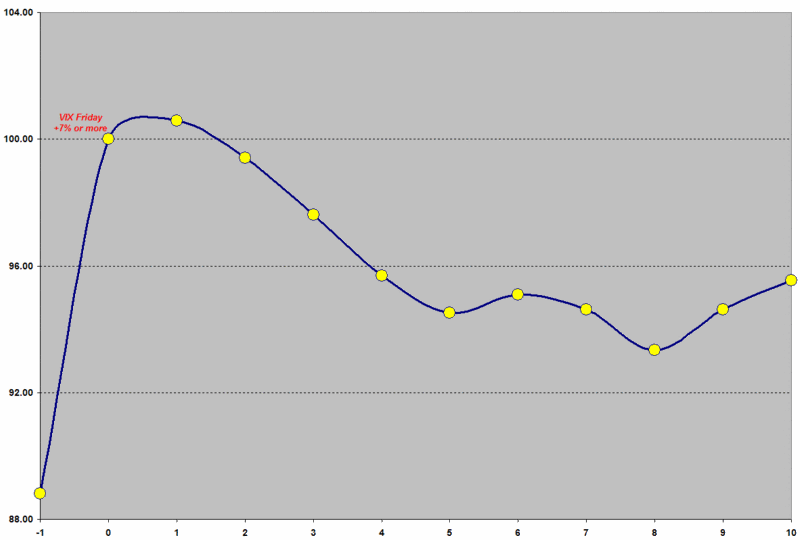
Getting back to the 7% rise on Fridays, as the adjacent composite graphic shows, there is typically a small (0.6%) follow-through on the day after the +7% Friday, with a gradual lessening of volatility over the course of the next 1 ½ weeks. The data for the high closes over the two weeks following these 45 Friday 7% spikes also supports the idea of the Friday spike and Monday follow-through as being the high point in this sequence is: fully 27% of the time, the Friday closed held up as the high close over the next two weeks; another 20% of the time, the Monday close turned out to be the high close during this period.

Going forward, keep in mind that many VIX spikes run out of steam 2-4 days after the initial move, so if Wednesday’s retails sales numbers or Bernanke's testimony does not put a scare into the markets and keep them on edge, the VIX spike will likely already have been trampled by the next bull leg.

For now I am slightly bearish on the VIX, with a close eye ready for the Tuesday-Wednesday action.

DISCLAIMER: "VIX®" is a trademark of Chicago Board Options Exchange, Incorporated. Chicago Board Options Exchange, Incorporated is not affiliated with this website or this website's owner's or operators. CBOE assumes no responsibility for the accuracy or completeness or any other aspect of any content posted on this website by its operator or any third party. All content on this site is provided for informational and entertainment purposes only and is not intended as advice to buy or sell any securities. Stocks are difficult to trade; options are even harder. When it comes to VIX derivatives, don't fall into the trap of thinking that just because you can ride a horse, you can ride an alligator. Please do your own homework and accept full responsibility for any investment decisions you make. No content on this site can be used for commercial purposes without the prior written permission of the author. Copyright © 2007-2023 Bill Luby. All rights reserved.
 
Web Analytics