Showing posts with label Monday. Show all posts

Monday, April 6, 2009

Today’s Jump in the VIX

Lately it seems like I am the only one who is not talking about the VIX. I find it particularly ironic that many of the same people who were pounding the table saying that the market could not bottom unless there was another dramatic VIX spike and high volume capitulation are now insisting that the markets cannot rally from current levels until the VIX continues down. I suspect these pundits will end up going 0 for 2 in their predictions.

For the record, at the very moment the SPX formed the “devil’s bottom” of 666.79 on March 6th, the VIX was at 51.65, which was not even the high for the particular day. By the end of the day, the VIX was down to 49.33 in what looks in retrospect like a classic stealth bottom.

So what is driving the VIX right now? In a previous post, I opined that a simplistic conceptual model of the VIX is one which “incorporates incremental changes in uncertainty and fear on top of recent historical volatility.” Many of the common measures of historical volatility (10, 20, 30 and 50 day) show that historical volatility in the SPX topped in the middle to latter portion of March. Since the 7.08% jump in the SPX on March 23rd, trading has been relatively subdued from a volatility perspective. As that 7.08% jump as well as the 6.37% and 4.07% jumps from March 10th and March 12th begin to scroll off the lookback window, historical volatility numbers should begin to lead the VIX back down.

As far as fear and uncertainty are concerned, the fear of a global systemic bank failure seems to be receding, while concerns about a deepening global recession are lingering and still rising in some quarters. The G-20 meeting underscored the willingness of leaders of the world’s largest economies to coordinate their activities, even if they cannot agree on the details of those coordinated efforts.

Finally, we are in a news cycle lull this week, but earnings season officially kicks off with Alcoa (AA) reporting tomorrow.

The bottom line is that current levels of the VIX are in line with historical volatility readings and changes in the macroeconomic landscape. The fear component of the VIX is clearly on the wane, which should mute any VIX spikes. On the other hand, historical volatility needs to continue to decline and the VIX term structure (which is based on SPX options) and VIX futures need to soften somewhat before the VIX can reasonably be expected to start trading in the 30s on a regular basis.

Many analysts have a tendency to rely too heavily on charts when looking at the future of the VIX. While charts can provide some useful information and it is nice to know that the VIX has recently moved below its 200 day moving average, sometimes putting the VIX in the proper geopolitical and macroeconomic context is a more valuable approach.

So…I think the VIX is about where it should be right now and stocks can resume their move up without the VIX being required to plummet. In fact, if the bulls continue to keep the upper hand, expect the VIX to decline in a decidedly gradual fashion.

Finally, the VIX jumped 3.1% today, while the SPX lost 0.83%. That -4x move is typical of the VIX, but not on Mondays, when ‘calendar reversion’ usually means the VIX jumps about 1.5%. Add to this the 1.53% that the VIX fell during the 4:00 – 4:15 p.m. ET index trading portion of Friday’s session and one could make the argument that the VIX barely moved at all today relative to the SPX.

For another perspective on the recent movements of the VIX, I recommend More Ways to Look at Volatility from Daily Options Report.

Friday, April 27, 2007

The VIX on Mondays After Options Expiration

A reader asked me what usually happens to the VIX on the Monday following options expiration.
The short answer is that since 1990, the VIX has risen an average of 2.9% on the Monday after options expiration. Looking at all five days of the week, the VIX has posted a mean daily increase of 0.16% since 1990. If you back out those Mondays following options expiration, however, the remaining increase is a mere 0.02% per day, meaning that these post-expiration Mondays have accounted for almost all of the cumulative upside movement in the VIX over the past 17 years.

For what it’s worth, I also looked at the subset of Mondays following quadruple witching days and determined that those results were statistically identical to the other post-expiration Mondays.

One statistic that I found particularly interesting is that 80% of the VIX gains on typical post-expiration Mondays and 90% of the gains following quadruple witching expirations are, on average, reversed in the course of the next three days. So the next time you see a post-expiration bump in the VIX, expect that by the following Thursday almost all of the move will have evaporated.

For more on the VIX action on Mondays, Fridays, and during the options expiration cycle, click on the appropriate label links at the bottom of this entry.

Monday, February 12, 2007

The VIX on Mondays and Fridays

It probably comes as no surprise to anyone who takes options seriously that the VIX is most likely to make a big move up or down on either Monday or Friday, but did you realize that the Friday moves are mostly up and the Monday moves are mostly down?

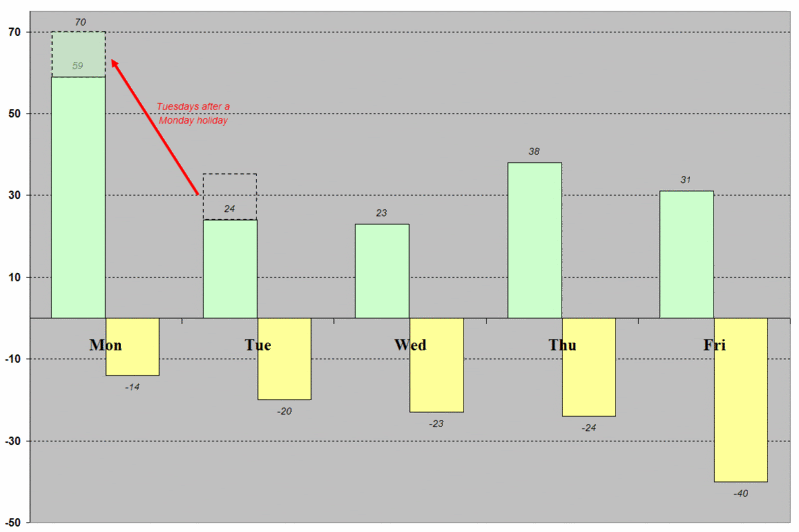
Today’s Excel cut and paste shows all the one day moves in the VIX of 10% or more since 1990. For starters, 61% of these have been up, while 39% have been to the down side. Monday sees by far the most VIX spikes up. If you add the 11 moves of 10% or more that happened on Tuesdays when the markets were closed for a Monday holiday (i.e., those indicated by the red arrow and dashed box), the pattern of a large plunge on the first trading day of the week becomes even more predominant, with 70 sessions of a 10% or greater VIX move up (shown in green) versus only 14 sessions with a 10% move down. On balance, Tuesdays and Wednesdays are relatively light in terms of large VIX moves to the upside, with activity picking up somewhat on Thursdays and Fridays.

Looking at 10% VIX moves down, the trend rides a slow and steady weekday crest, starting from a Monday low and moving up a little each day, with Friday the big winner in the spike down sweepstakes.

I am not yet ready to speculate on the causes of the Friday volatility drops and the Monday and post-holiday Tuesday VIX surges, other than to point out that even following 9/11, when the country appeared to hold its collective breath over the weekend, this pattern seemed to hold.

I will note that in the past couple of years, some of the patterns in the weekday trends may have weakened a little, but for the most part, they have held up in periods when the VIX has been at historically high levels as well as historically low levels.

There are many potential implications to be drawn from this data. Specific to the current rise in the level of the VIX, keep in mind that VIX spikes on a Tuesday or a Wednesday may have more significance than those that straddle the weekends.

For now I am bearish on the VIX and expect that the current VIX uptrend will run its course by Wednesday. If it does not, however, I would think that 15 and perhaps 20 are in play before the month is over.

DISCLAIMER: "VIX®" is a trademark of Chicago Board Options Exchange, Incorporated. Chicago Board Options Exchange, Incorporated is not affiliated with this website or this website's owner's or operators. CBOE assumes no responsibility for the accuracy or completeness or any other aspect of any content posted on this website by its operator or any third party. All content on this site is provided for informational and entertainment purposes only and is not intended as advice to buy or sell any securities. Stocks are difficult to trade; options are even harder. When it comes to VIX derivatives, don't fall into the trap of thinking that just because you can ride a horse, you can ride an alligator. Please do your own homework and accept full responsibility for any investment decisions you make. No content on this site can be used for commercial purposes without the prior written permission of the author. Copyright © 2007-2023 Bill Luby. All rights reserved.
 
Web Analytics