Showing posts with label DJTA. Show all posts

Monday, April 4, 2011

Chart of the Week: Crude Oil and Transports

With crude oil prices hovering around $108/bbl. level, it is only natural to begin wondering just what kind of impact crude prices will have on stocks.

Looking back at recent history, crude oil and stocks have been positively correlated, largely because an improving economy translates into increased demand for crude oil. At some point, of course, rising crude oil prices are going to translate into a drag on GDP and on equities. Consensus estimates for the impact of crude oil on GDP generally assign about a 0.25% drop in U.S. GDP for every $10 increase in crude oil.

Whether the negative correlation between crude oil and stocks begins to become apparent at $110 or perhaps at higher levels remains to be seen.

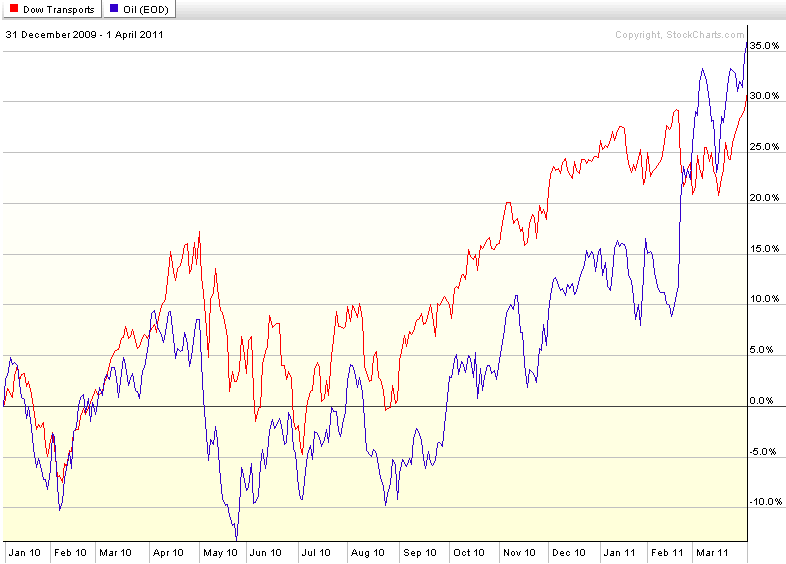
When oil prices begin to be a significant drag on stocks, it will likely show up first in the transportation sector. Looking at the Dow Jones Transportation Average (DJTA) and (West Texas Intermediate) crude oil prices since the beginning of 2010 in this week’s chart of the week, it is obvious that the positive correlation between crude oil prices and transports has continued all the way up to the present. While I expect this positive correlation to end shortly, as long as transports continue to move up in concert with rising crude oil prices, investors should feel comfortable with their long positions in equities.

Related posts:


[source: StockCharts.com]

Disclosure(s): long crude oil futures at time of writing

Sunday, August 1, 2010

Chart of the Week: Transports Leading…

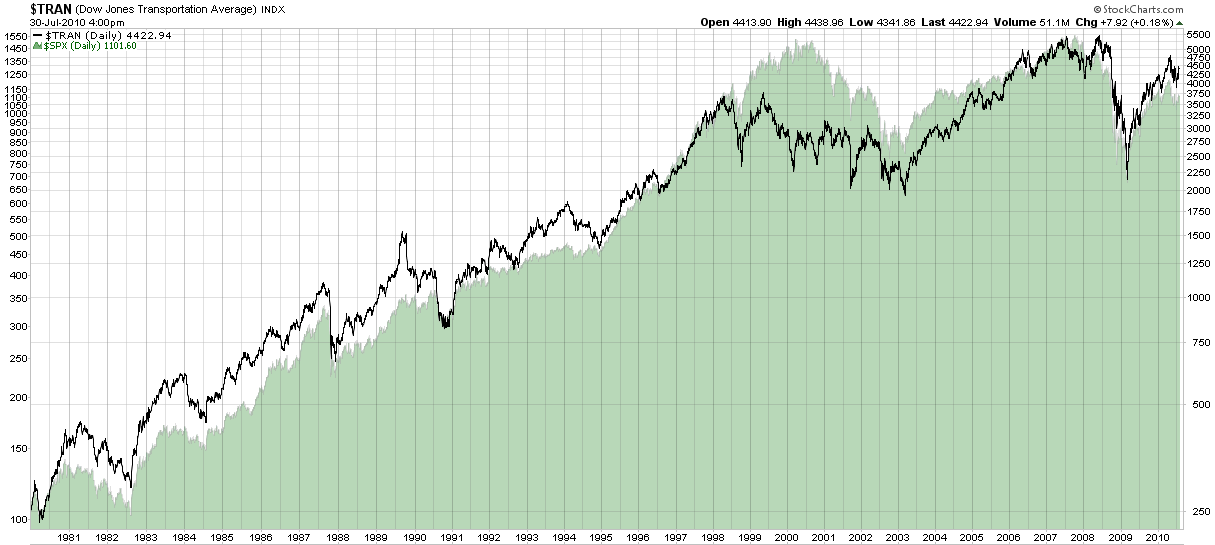
For this week’s chart of the week, I have elected to shine some light on the Dow Jones Transportation Average (DJTA), which is revered by Dow Theory adherents, yet often underappreciated by a larger group of investors.

Since the March 2009 bottom, high relative strength readings in the transports have tended to precede significant bull moves in the broader markets. Rather than spell out how the transports might be a leading market indicator, I have chosen to use the chart below to show the performance of the DJTA over the course of the last thirty years and encourage readers to dig deeper. In my experience, the transports are generally an excellent proxy for the health of broader economy. Given the way the markets have recently reacted to earnings from FedEx (FDX) and have done so similarly for UPS, Union Pacific (UNP), Ryder (R) and others in the past, it appears as if I have a fair amount of company.

For more on related subjects, readers are encouraged to check out:


[source: StockCharts.com]

Disclosure(s): none

Monday, October 26, 2009

Breaking Down the Weakness in Transports

Yesterday’s Chart of the Week: Falling Transports looked at the recent weakness in the Dow Jones Transportation Average (DJTA) and included a study of the performance of the index relative to the S&P 500 index.

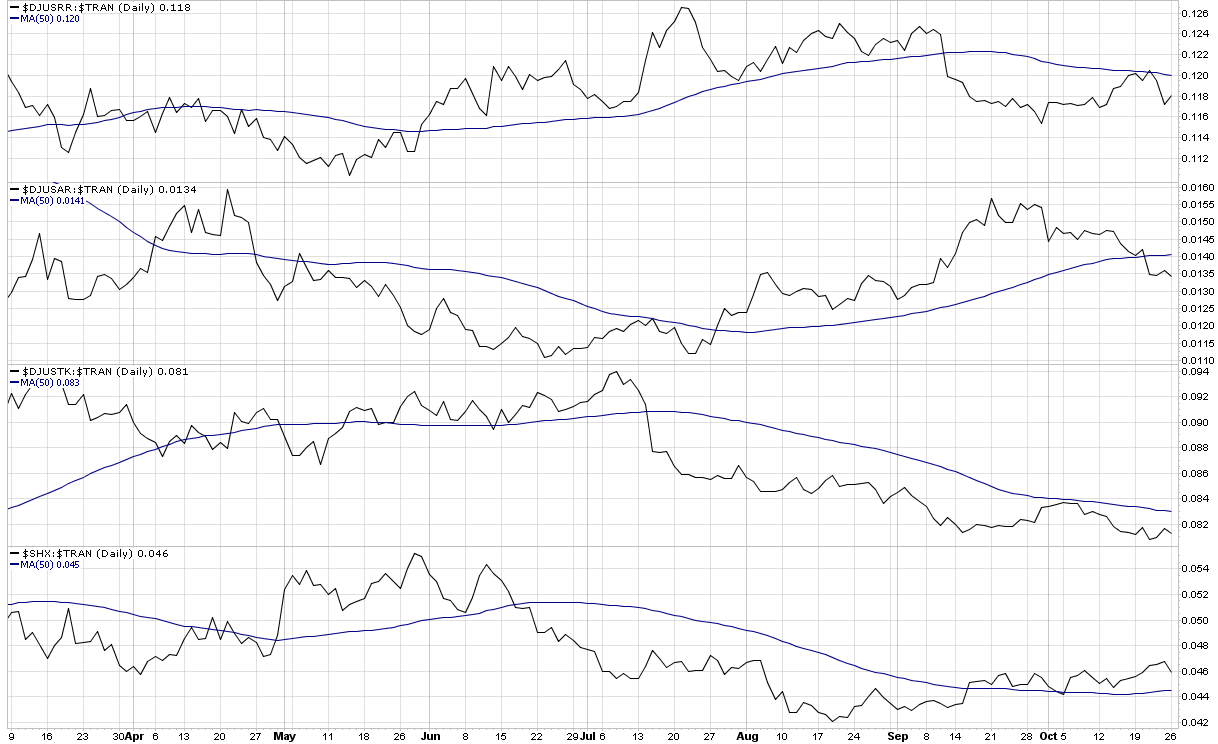
Today I am going to look under the hood of the DJTA and highlight four often overlooked transportation sub-sector indices:

  • Dow Jones US Railroad Index ($DJUSRR)
  • Dow Jones US Airlines Index ($DJUSAR)
  • Dow Jones US Trucking Index ($DJUSTR)
  • PHLX Marine Shipping Index ($SHX)

The chart below, which plots each of the above sub-sector indices as a percentage of the DJTA shows that airlines have been the biggest laggard relative to the broader transportation average over the course of the past month, while railroads and truckers have also not been able to keep pace with the DJTA as of late. The relative strength in the transportation sector has come from the marine shippers – a point that is bolstered by the recent strength in the Baltic Dry Index (not shown in the charts.)

While I have yet to see any ETFs for the railroad and trucking sectors, two ETFs that are available are the popular Claymore/Delta Global Shipping ETF (SEA) and the less active Claymore/NYSE Arca Airline (FAA).

For additional posts on the transports and their sub-sector indices, readers are encouraged to check out:

[source: StockCharts]

Sunday, October 25, 2009

Chart of the Week: Falling Transports

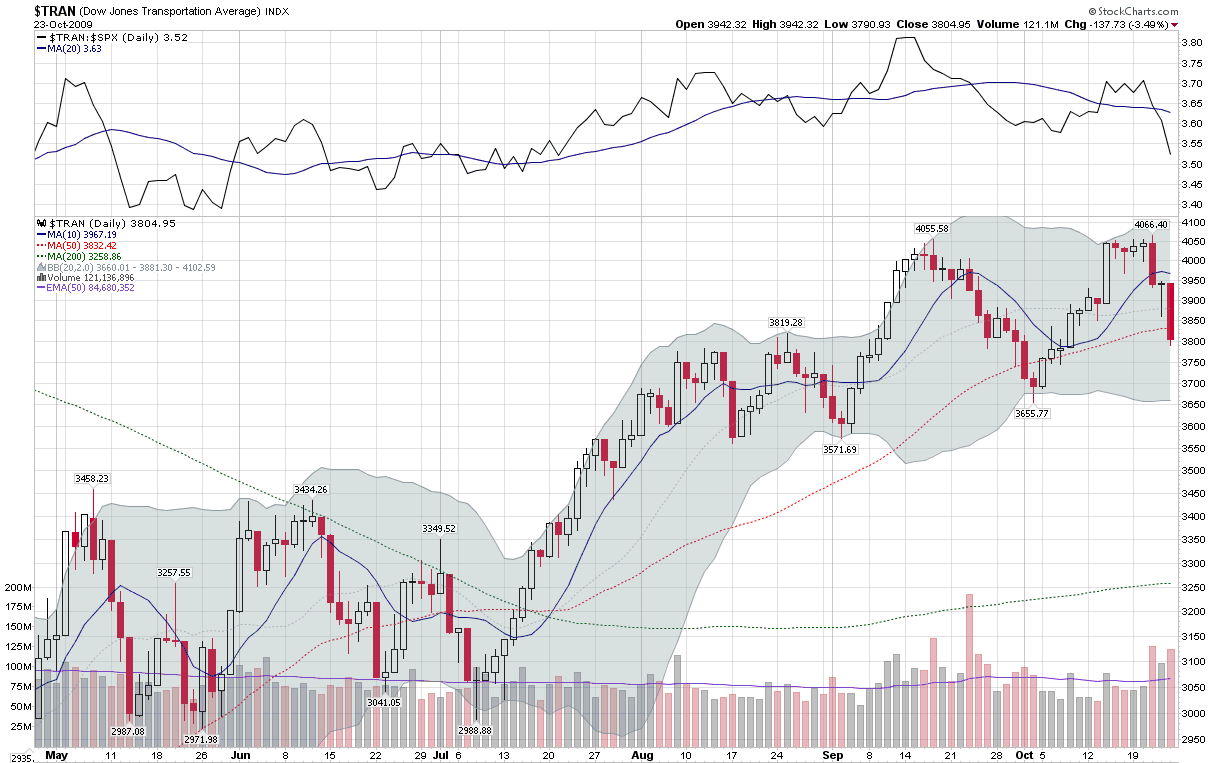
For the most part, last week saw some mild negative numbers in most of the major market indices. One particular index that is closely watched by many, however, was particularly hard hit. The Dow Jones Transportation Average (DJTA), an essential component of Dow Theory, fell 5.4% for the week and was particularly hard hit on Friday.

Before the market opened on Friday, two of the three railroads in the DJTA reported earnings and while the bottom line numbers were impressive, investors were spooked by substantial revenue declines. Burlington Northern Santa Fe (BNI) reported a quarterly revenue decline of 27% from the comparable quarter in 2008, while Union Pacific (UNP) reported a 24% drop in revenues for the same period. The weak revenue picture helped to push the DJTA to a loss of 3.5% on Friday and create what looks for now to be a provisional double top in the index in the chart of the week below.

While I am by no means a strict adherent to Dow Theory, I do think the transports are important to watch, particularly when they signal a different economic client than is being reported by the manufacturing sector. The transports will be an important sector to watch going forward.

[source: StockCharts]

Friday, May 16, 2008

The Shift from Roads to Rails

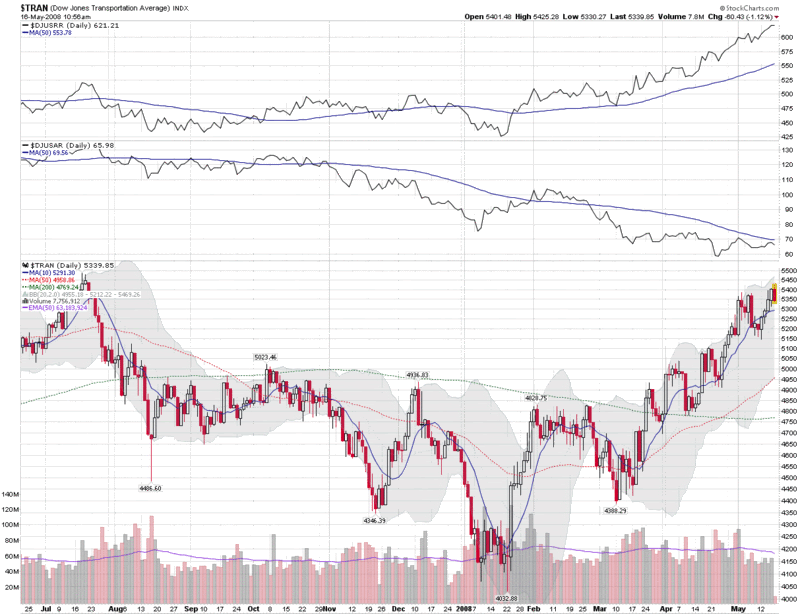
The Dow Jones Transportation Average (DJTA) has a long and storied history, but has been frequently overlooked in recent years. Despite this secondary billing, the index is up over 30% since bottoming in January and is close to challenging last summer’s all-time high.

The transports are often thought of as a barometer of the cyclical economy, frequently rising as an economy transitions from recession to recovery. As such, the rise in this index has been noted by many observers as a sign of better economic times ahead.

The reality is that the transportation index aggregates several related industries, including commercial airlines, shipping companies, railroads, truckers, and air freight firms. These firms have had widely varying fortunes lately and the outlook is different from segment to segment. One important distinction between these companies is their exposure to rising fuel costs. Not surprisingly, airlines and truckers have been hit hard by rising energy prices. Shippers and railroads, however, have suffered less of an impact. The distinction is dramatic when drawn between railroads and airlines. In the chart below, I have included not only the DJTA, but the Dow Jones US Railroad Index ($DJUSRR) and the Dow Jones US Airlines Index ($DJUSAR). The chart shows what most of us already know: the rails are booming and the airlines are struggling.

Energy costs are tilting the balance of power away from airlines and truckers back toward the traditional bulk carriers: railroads and shipping companies. In an era of rapidly expanding global trade, not only will the winners be the ones with a significant cost advantage, but their growing market share and growing markets should make for some enticing investment opportunities.

DISCLAIMER: "VIX®" is a trademark of Chicago Board Options Exchange, Incorporated. Chicago Board Options Exchange, Incorporated is not affiliated with this website or this website's owner's or operators. CBOE assumes no responsibility for the accuracy or completeness or any other aspect of any content posted on this website by its operator or any third party. All content on this site is provided for informational and entertainment purposes only and is not intended as advice to buy or sell any securities. Stocks are difficult to trade; options are even harder. When it comes to VIX derivatives, don't fall into the trap of thinking that just because you can ride a horse, you can ride an alligator. Please do your own homework and accept full responsibility for any investment decisions you make. No content on this site can be used for commercial purposes without the prior written permission of the author. Copyright © 2007-2023 Bill Luby. All rights reserved.
 
Web Analytics