Showing posts with label Baltic Dry Index. Show all posts

Monday, October 26, 2009

Breaking Down the Weakness in Transports

Yesterday’s Chart of the Week: Falling Transports looked at the recent weakness in the Dow Jones Transportation Average (DJTA) and included a study of the performance of the index relative to the S&P 500 index.

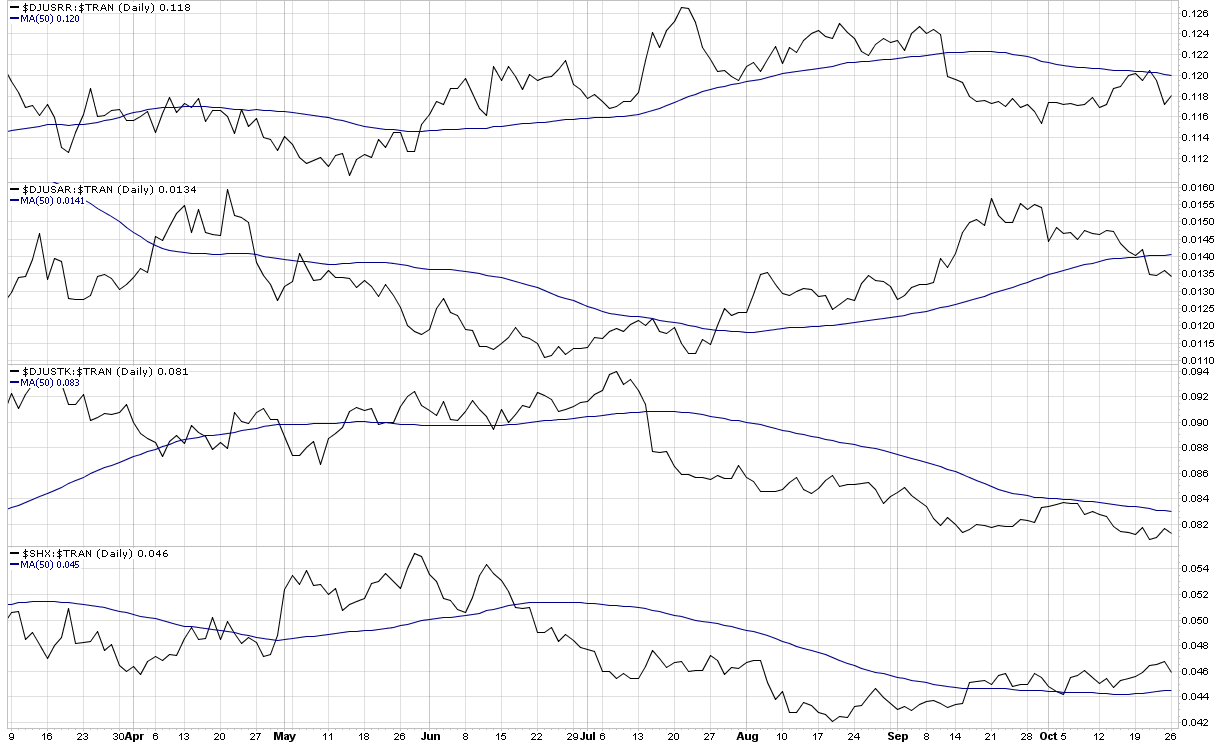
Today I am going to look under the hood of the DJTA and highlight four often overlooked transportation sub-sector indices:

  • Dow Jones US Railroad Index ($DJUSRR)
  • Dow Jones US Airlines Index ($DJUSAR)
  • Dow Jones US Trucking Index ($DJUSTR)
  • PHLX Marine Shipping Index ($SHX)

The chart below, which plots each of the above sub-sector indices as a percentage of the DJTA shows that airlines have been the biggest laggard relative to the broader transportation average over the course of the past month, while railroads and truckers have also not been able to keep pace with the DJTA as of late. The relative strength in the transportation sector has come from the marine shippers – a point that is bolstered by the recent strength in the Baltic Dry Index (not shown in the charts.)

While I have yet to see any ETFs for the railroad and trucking sectors, two ETFs that are available are the popular Claymore/Delta Global Shipping ETF (SEA) and the less active Claymore/NYSE Arca Airline (FAA).

For additional posts on the transports and their sub-sector indices, readers are encouraged to check out:

[source: StockCharts]

Tuesday, March 10, 2009

Rising Baltic Dry Index a Sign of a Commodities Bottom?

On the last day of 2008, I urged readers to Watch the Baltic Dry Index in 2009 for clues about the strength of global trade.

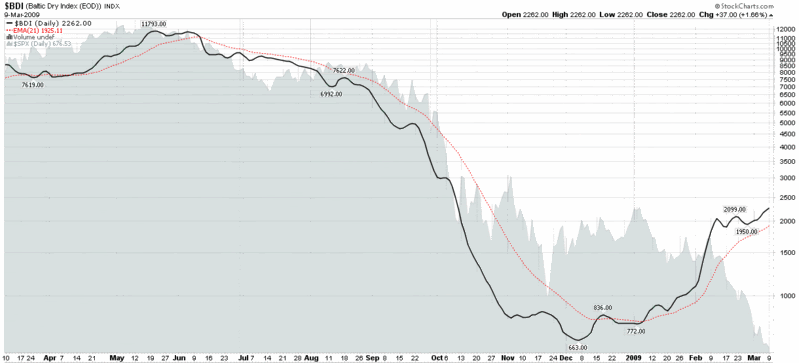
To quickly recap, the Baltic Dry Index (BDI) measures shipping rates for dry bulk carriers that carry commodities such as coal, iron and other ores, cocoa, grains, phosphates, fertilizers, animal feeds, etc.

While I have previously chronicled the dramatic drop in production in several of the world’s most important export economies, according to the Baltic Dry Index, shipping rates started moving up in December and have turned up sharply in the past six weeks. Since the beginning of the year, crude oil and copper prices have begun to firm and commodities in general have been outperforming on a relative basis. To be fair, some of the bullish action in commodities has been due to expectations about an increase in the proposed Chinese stimulus package. Given that recent announcements from Beijing have disappointed those looking for new stimulus measures, however, one now has to consider that the BDI and commodity prices have been able to extend their recent gains without the help of increased government spending plans. This development raises the possibility that commodities may indeed be in the process of bottoming.

[source: StockCharts]

Wednesday, December 31, 2008

Watch the Baltic Dry Index in 2009

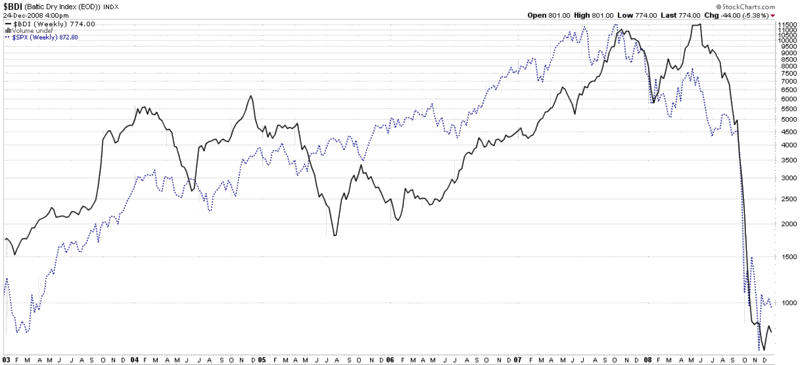
In 2009 investors will be scanning the globe for signs of economic recovery or deterioration. Among the many tools they should be watching in order to gauge the strength of global trade is the Baltic Dry Index (BDI.) The Baltic Dry Index measures shipping rates for dry bulk carriers that carry commodities such as coal, iron and other ores, cocoa, grains, phosphates, fertilizers, animal feeds, etc. In short, the BDI is an excellent proxy for global trade.

In the chart below, note how the BDI peaked after the S&P 500 index did in 2007 and bottomed after the SPX last month. The BDI may not be a leading indicator, but it is an important way to confirm whether moves in global equities are being reflected in an increase in global shipping. If the BDI fails to rally in 2009, be skeptical of any rally in stocks.

For those who are interested in following stocks of some of the leading dry bulk carriers, a good place to start is with Diana Shipping (DSX), DryShips (DRYS), and Excel Maritime Carriers (EXM).

[source: StockCharts]

DISCLAIMER: "VIX®" is a trademark of Chicago Board Options Exchange, Incorporated. Chicago Board Options Exchange, Incorporated is not affiliated with this website or this website's owner's or operators. CBOE assumes no responsibility for the accuracy or completeness or any other aspect of any content posted on this website by its operator or any third party. All content on this site is provided for informational and entertainment purposes only and is not intended as advice to buy or sell any securities. Stocks are difficult to trade; options are even harder. When it comes to VIX derivatives, don't fall into the trap of thinking that just because you can ride a horse, you can ride an alligator. Please do your own homework and accept full responsibility for any investment decisions you make. No content on this site can be used for commercial purposes without the prior written permission of the author. Copyright © 2007-2023 Bill Luby. All rights reserved.
 
Web Analytics